Seasonal Landscapes

Turning a Sloped Property Into a Water-side Walking Trail

While many of us love nature walks, we don’t all have easy access to hillside trails. Well, imagine being able to enjoy a nature trek any day you feel like it. It’s possible, if you’re fortunate enough to have an unused area of sloping yard.

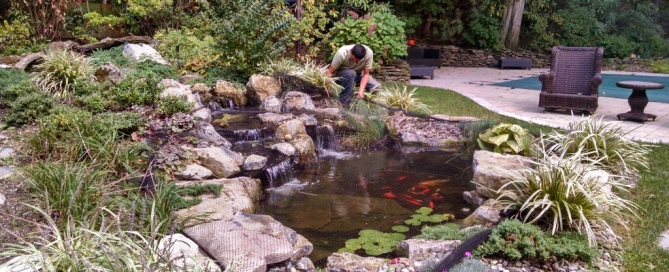
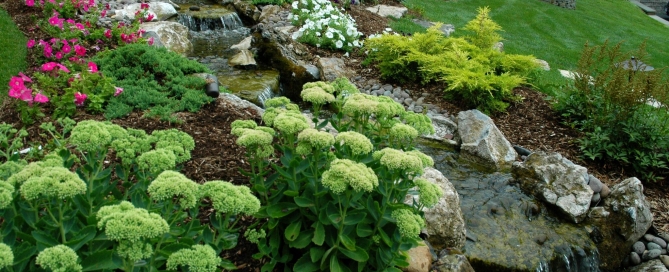
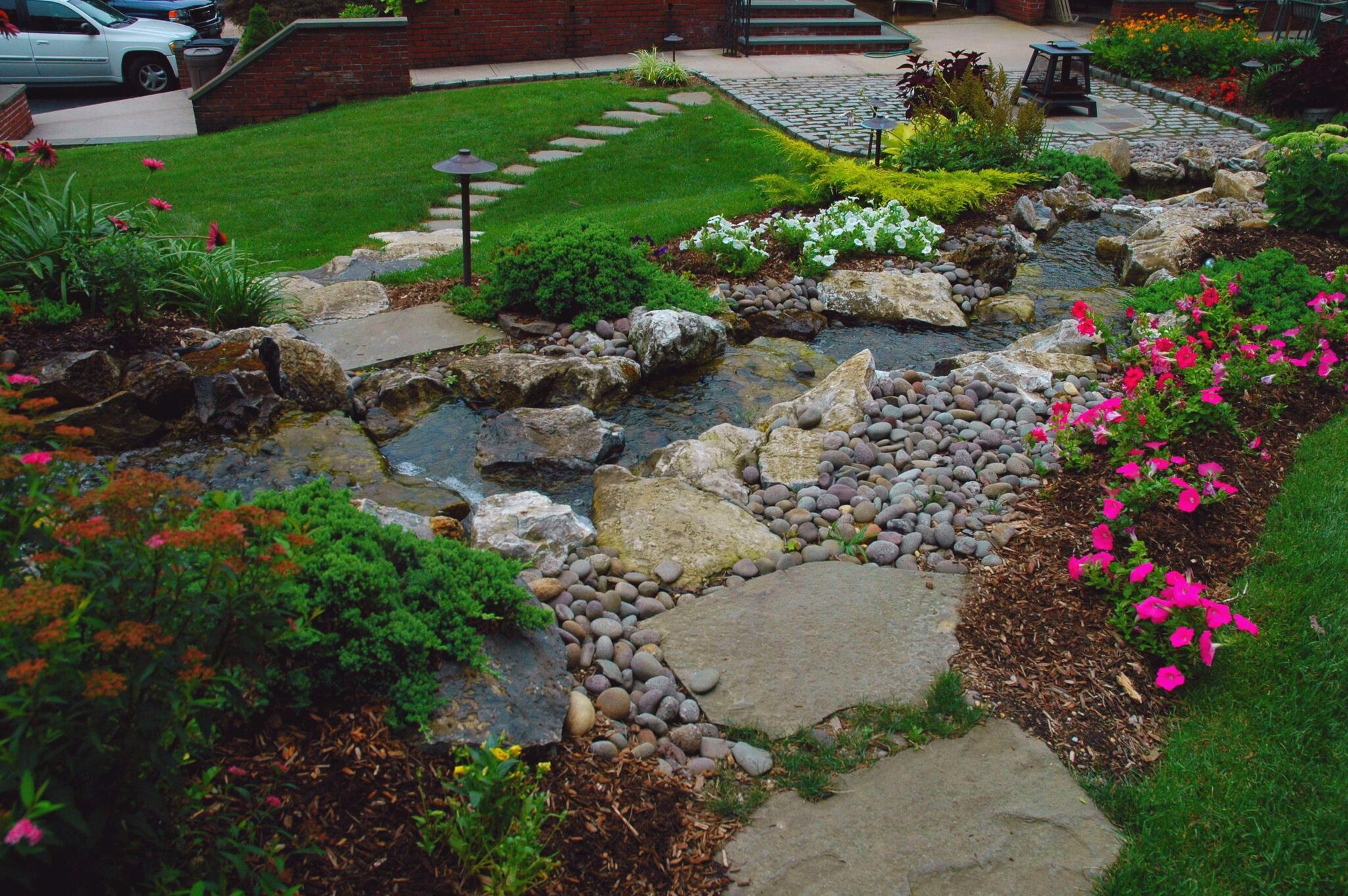
That was the case for this award-winning project showcase. Their property had an unused slope near their patio. This allowed Deck and Patio to design/build a 35-foot-stream, with two stepping stone paths on either side, that gently moves along the grade solely with the help of Mother Nature’s gravity. We also positioned natural moss rock boulders and plantings, as well as river stones along its banks to make a perfect area for strolling, bird-watching, etc.

At the end of the stream, the water falls over moss rock into a 10-foot-by-15-foot fish pond. Here, the adjacent landscape is graced with tall grasses (e.g., Miscanthus) and evergreens such as Juniper Parsoni, which provide a lush backdrop to it all.

“The whole area attracts so much wildlife — like frogs and birds,” says the homeowner. “This is really one of our favorite things about having a stream and pond.”

The homeowners say they also enjoy the sounds of the waterfalls and the serenity they feel watching the fish swimming in the pond. “It’s something we look forward to at the end of a long day.”

This project earned The Deck and Patio Company a Silver Award from the Northeast Spa and Pool Association (NESPA).


Backyard Stream and Pond (Long Island/NY):

Backyard Stream and Pond (Long Island/NY):

This beautiful watery trail meanders along a formerly unused slope in the clients’ backyard. Gravity is a very energy-efficient way to make the water move forward. During winter, the moss rock boulders become stunning ice sculptures that beautifully extend the seasonal enjoyment of it all.


Landscaping Ponds (Long Island/NY):

Landscaping Ponds (Long Island/NY):

Deck and Patio added such lovely bursts of color as Purple Cone flowers,  Coreopsis and Spirea Anthony Waterers. In addition, tall grasses, deep green ground cover, along with the peaceful sounds of moving water, totally captivate the senses. All this can be viewed from the pool area, back patio, as well as the house.


Picture-Perfect Waterfalls (Long Island/NY):

Picture-Perfect Waterfalls (Long Island/NY):

It takes expertise and experience to position rocks in such a way as to coax water into waterfalls just like it happens in nature. Members of Deck and Patio’s team enjoy the woods and hillsides of upstate New York — frequently stopping and studying how water flows over rock, how plants crop up alongside of such water trails, etc.
 

Backyard Upgrades (Long Island/NY):

Backyard Upgrades (Long Island/NY):

Our design plan called for an extended patio with bluestone stepping stones leading to the stream, natural stones to walk across it, and more bluestone on the other side up to the pool area.


Nature-Loving Family (Long Island/NY):

Nature-Loving Family (Long Island/NY):

This stunning free-form pond is a huge hit with the clients’ entire nature-loving family. Everyone enjoys feeding and watching the vibrant koi as they swim about in it. “We even get to enjoy it all at night,” says the wife. “And we can see it from our home and offices, too.”


Upgrading Pool and Backyard: New Landscaped Slope Replaces Old Retaining Wall

As part of an overall backyard upgrade, Deck and patio was asked to replace a deteriorating two-tiered retaining wall that had become an unsightly focal point of the clients’ pool and patio area. In addition, loud noises that came from behind the wall were a problem. Other elements that needed refurbishing were the pool’s bowing stack concrete wall, and an aging patio.

To renovate the pool, we reinforced its wall with steel rebar and filled blocks with concrete; we also reshaped its design into an elegant geometric form. In addition, Deck and Patio surrounded the pool on three sides with a durable and handsome Cambridge patio.

Work in Progress

Work in Progress

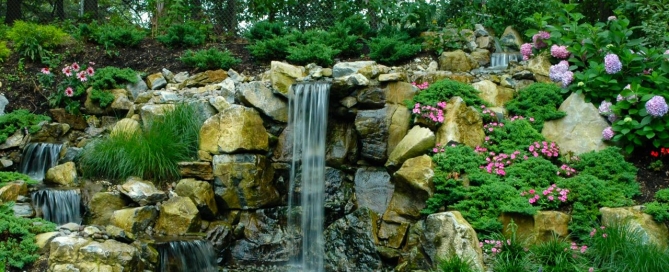
Transforming the dual four-foot retaining walls called for a major transformation: removing and replacing the walls, and filling the space with naturalized boulders before colorful plantings, and a seven-foot high water feature could be added. Deck and Patio’s project manager/designer for the job was Bill Renter, who is an avid outdoor enthusiast.

“I spend as much time as I can walking the hillsides of New York’s Catskills and studying the landscape,” says Renter. “This has increased my expertise in how rock placement affects the flow of streams and waterfalls.”
Indeed, over the years, Renter has received a multitude of awards for choosing the perfect rocks, and artfully installing them to great effect and function.


INSERT # 2


Seven-Foot High Waterfall

Replaces Old Retaining Wall


“Bill wanted our clients to experience what he does when he explores nature,” adds Dave Stockwell, owner of Deck and Patio.
“Not only did he create a beautiful focal point behind the pool, the dramatic waterfall drops into a pond-less system by Aquascape that filters and collects the water underground to recirculate it. Not having a pond capturing the falling water allowed Bill to add a stepping stone path that bring strollers right up to the fall, as if they were on a nature walk in the mountains.”


Backyard Upgrade Before and After:


Before Photo of Pool and Retaining Wall

Before Photo of Pool and Retaining Wall


After Photo of Pool/Retaining Wall

After Photo of Pool/Retaining Wall


Cambridge Pavingstone Patio:

Cambridge Pavingstone Patio:

Replacing the clients’ old patio with Cambridge Sahara Chestnut pavers included this new handsome entrance to the pool area with a spectacular view of  of the new natural retaining wall.


Natural Noise Barrier:

Natural Noise Barrier:

The new seven-foot waterfall is not just a delightful feature, it serves as a natural noise barrier for unwanted sounds that might intrude on a serene backyard oasis such as this.


Natural Retaining Walls:

Natural Retaining Walls:

Plantings are a key part of creating any natural retaining walls. Along with boulders and other rocks, their root systems add to the overall strength of the support system. Deck and Patio always chooses plants for their color, bloom periods and how they grow — ensuring color all through the seasons that keep their harmony year after year.


Here’s one additional “before” and “after” grouping that highlights the process of replacing a  retaining wall.

New Wall Includes Aquascape Pondless Waterfall

New Wall With Aquascape Pondless Waterfall

Natural Retaining Wall as a Work in Progress

Natural Retaining Wall as a Work in Progress


Earth Day 2016: Attracting Butterflies to Home Gardens


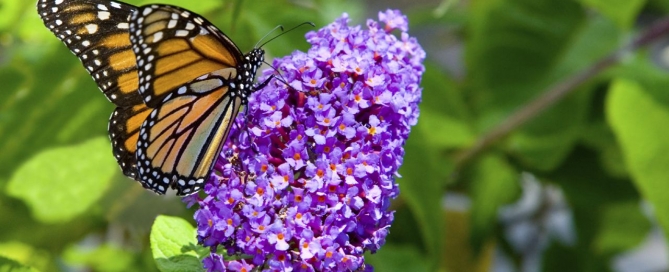
Monarch Butterfly

Monarch Butterfly

As landscapers, Deck and Patio’s team is frequently asked by homeowners to plant flowers that will attack butterflies. Yet even we were surprised at how widespread the desire for butterfly gardens has become.

In speaking recently with our friends at Hicks Nurseries, in Westbury, we learned that they have seen a huge spike in the purchase of pollinator-friendly plants, as well as a large uptick in the size of audiences attending seminars on the subject.

“Those interested are outdoor people, who traditionally enjoyed creating gardens that brought in birds to feeders and provided opportunities to watch butterflies,” says Caldwell. “More and more, however, we’re seeing a desire to create safe havens for butterflies, as well as other pollinators, including bees and hummingbirds.”

Caldwell says the growing awareness in how pesticides has affected the pollinator populations has helped stir this awakening. “Butterflies and other animal groups are having trouble with repopulation because it is so hard for them to find pure food sources. Butterflies, for example, often use too much energy hunting for food.

“It’s also key to create a safe habitat for their caterpillars. Some herbs are ideal for that; Dill and Dutchman’s Pipe, for example, not only provide caterpillars food, but also protective cover before they turn into butterflies.”

Organic gardening and environmentally-friendly lawn care products go hand-in-hand with protecting and attracting the pollinators, Caldwell adds. Dave Stockwell, owner of Deck and Patio, agrees.

“Earth-friendly lawn and plant care is very possible,” he says. “It isn’t essential to go for a fast kill of plant disease and pests. In doing that, you might also hurt helpful organisms in the process. Heavy use of toxic chemicals are also dangerous to pets and children. It is much healthier to control them — and protect butterflies and other pollinators in the process — through a more organic approach.”

As for ideal food, tubular-shaped plants or “Umbrels” provide a wonderful sanctuary for butterflies. “These give them a landing plant filled with nectar just waiting for them,” says Caldwell. She also suggests a seasonal approach that not only provides multi-seasonal color in gardens, but extra months of safe, bountiful habitats.

“In spring, you can plant Columbine, Bachelor Buttons, Bleeding Hearts, and Dianthus, for example. In summer, there’s 30-40 plants to choose from, including Black Eyed Susan, Butterfly Weed, Butterfly Bush to name just a few. In fall, there’s Sedums, Joe Pye Weed, Asters, and Golden Rod.”


Butterflies will get plenty of moisture from droplets left from sprinklers, morning dew, etc. “However, they do seem to love oranges, not only for food, but to quench their thirst,” says Caldwell. Note: To keep ants away from the fruit, put the slice on a smaller dish and insert it into a larger one with water. Also, cut fresh slices into the fruit every day.

“We were delighted to learn that so many Long Islanders are helping, in their own quiet way, to help the environment” says Dave Stockwell. “They’re celebrating Earth Day, every day, by creating safe, beautiful habitats for butterflies and other pollinators.”


Butterfly Bush (Photo: Hicks Nurseries)

Butterfly Bush (Photo: Hicks Nurseries)

As the name implies, Butterfly Bush is a great choice for attracting butterflies in the summer. “They can reach up to 6-8 feet in height,” says Caldwell. “They’re fast growing and don’t need a lot of care.”


Lavender and Butterflies:

Lavender and Butterflies:

Dave Stockwell (Deck and Patio) says that Lavender (shown here) is another plant butterflies love. “It also gives off a calming peaceful scent. There are several types of lavender that bloom at different times — so you can have its perfume from spring nearly through fall.”


Black Eyed Susans (Photo: Hicks Nurseries):

Black Eyed Susans (Photo: Hicks Nurseries):

Great for attracting butterflies, these biennials are also a haven for other pollinators like bees. Their bright yellow petals and dark centers can’t help but make you smile.


Earth Day 2016 Earth Day coincides with the signing ceremony for the Paris Agreement on Climate Change. Photo from WMO

Earth Day 2016 Earth Day coincides with the signing ceremony for the Paris Agreement on Climate Change. Photo from WMO

This is the first of a two-part series in honor of Earth Day 2016 (April 22nd). Next week, our blog will cover sustainable water features and rainwater harvesting. 


The Pond Life: Spring Cleaning Is for Ponds, Too

For pond lovers, the advent of spring means more than cleaning away dust bunnies behind the fridge. If you have a backyard pond, and depending on its size and what part of the country it is located, some degree of pond cleaning is an equally important rite of spring.

As certified Aquascape Inc. contractors, many local pond owners prefer that someone from our Deck and Patio team come and prepare their pond come spring. But, avid pondsters (is that a word?) who don’t mind putting on some boots and getting their hands dirty are happy to do it all themselves, or at least part of it.

What’s involved?

In the north, fall brings debris! Photo Aquascape Inc.

In the north, fall brings debris! Photo Aquascape Inc.

If your aquatic plants were not properly cut back in fall, they may very well have fallen back into the pond and decomposed and dirtied the water.

However, even if you did cut them back, some cleaning will probably be required. How much cleaning may depend on your pond’s size. Smaller ponds tend to have more impurities than larger ones.

“It’s not unlike a fish bowl verses a fish tank,” says Dave Stockwell, owner of Deck and Patio. “A fish tank is much easier to maintain than a fish bowl, isn’t it? There’s just more water to absorb impurities. However, even larger ponds require basic maintenance, such as cleaning out the filtration systems, fertilizing aquatic plants, adding new filter mats when required, etc.”

Dave adds that depending on the quality of the water, draining of the pond, rinsing it out, and refilling it using a de-chlorinator may be required as well.

Here’s a helpful video by Aquascape Inc. showing spring cleaning:


“If you’re draining the pond, it’s important to take great care of any pond fish during the process,” says Dave. “Keep them safe in a kiddie pool or the like, and put a net over them so they don’t jump out. Also, be sure to acclimate them during reentry.”

Here’s some tips from Forrest Churchill for how best to integrate your pond fish back into the cleaned pond:


Pond Maintenance:

Pond Maintenance:

In the north, one of the best things you can do to reduce spring clean up is to use pond netting during fall foliage season. Photo: Aquascape Inc.


 Pond-less Waterfalls:

Pond-less Waterfalls:

It will take much less time to clean up a pond-less waterfall (pictured above) than a pond basin. Just dig out any debris in the Pond-less Waterfalls Snorkel Vault and, if it is required, drain the water using a clean-out pump placed into the vault — being careful not to flood any particular area.


Spring Pond Cleaning:

Spring Pond Cleaning:

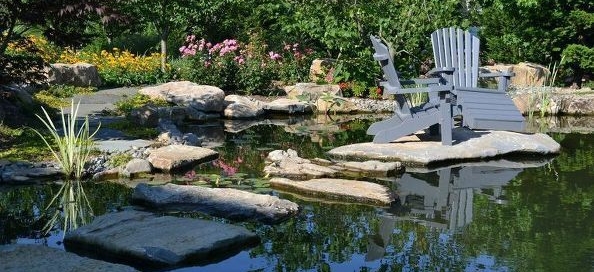
The larger the pond, the better quality the water will be come spring. This beautiful pond project is really two ponds (one shown); in the larger pond pictured here there was even room for adding a large stone island with stepping stones out to it, where two Adirondack chairs were positioned for periods of contemplation and feeding the koi.


Spring Cleaning Begins in Winter:

Spring Cleaning Begins in Winter:

Even if you cut back your aquatic plants and water grasses, some will decompose. When doing spring cleaning, be sure it’s before the pond water temperature gets  above 55 degrees. Otherwise, bacteria from the warmer water will have formed — causing another undesirable green phase.  Photo: Aquascape Inc.


Natural Swimming Ponds:

Natural Swimming Ponds:

Spring pond cleaning is essential for a pond pristine enough to swim in (even if you don’t wish to). Remember, all bacteria isn’t bad, some good bacteria kill the bad guys. A healthy natural swimming pond is very possible and is worth all the care you give it. The right bog filtration and water plants, along with Biofalls (such as Aquascape Inc.’s) support your seasonal care for a healthy water feature.


The goal, of course, is that any pond at a minimum be healthy for fish and aquatic plants. This kind of water feature is a joy to sit by, listen to, and pond-er spring.


What is Involved in Creating a Backyard Oasis Landscape?

You know it when you see it, a backyard so tranquil and lovely — and beautifully designed for entertaining — that it didn’t come about without expert planning.

Of course, you’ll no doubt turn to a professional to install any pool or spa, and perhaps the deck or patio areas. But for you hardy do-it-yourselfers out there, if you want to do the landscaping yourself, for picture-perfect, and useful, outdoor living spaces, here’s a few tips.

It is key to learn which plantings work well together, their bloom periods, those that thrive in full or partial shade, as well as plantings that will need the least care.

In addition, a beautiful backyard retreat can require selectively removing what is already there: trees and shrubs, as well as undesirable rocks and boulders that may be in the way. It’s also important to learn what is needed to nourish your particular property’s soil.

When it comes to soil nutrients, there are several places you can go for information, such as the Cornell Cooperative Extension in your area, where experts can guide you and sometimes even help analyze the soil.

As for the landscape design plan, take into consideration your home’s architecture as well as your style preferences.

“It’s also key to pay close attention to your property grades,” adds Dave Stockwell, owner of Deck and Patio. “We plan so that the landscape will flourish and last for years. Our designs include a layering technique that offers privacy on the periphery and vibrancy where it will be best enjoyed.”

Dave adds that another trademark of great design is the careful combining of ‘softscape’ with ‘hardscape.’ “Careful placement of moss rock will also add to the dimension and texture and a natural appearance.”


Landscaping Techniques:

Landscaping Techniques:

Because this property was open on three sides with three homes in full view, we added Skip Laurels, Leyland Cypress, and Cedars on the periphery to create a natural privacy screen. Texture and color were brought in to the buffering divider by incorporating flowering deciduous shrubs.


Landscaping Techniques:

Landscaping Techniques:

For the same project above, Deck and Patio’s Marc Wiener incorporated creeping evergreen ground covers that cascade and wind over and between the rocks we used. His selection of plants provide color from April through October; the whole design flows beautifully into the back property.


Year Long Garden Color:

Year Long Garden Color:

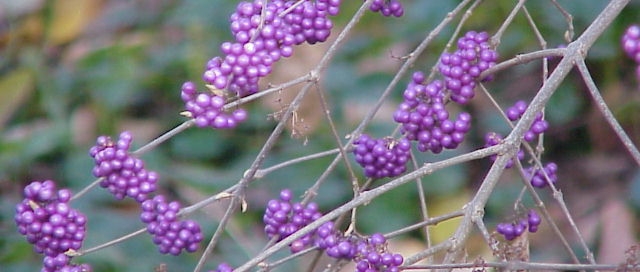
Sandra Vutaggio, Horticulture Consultant at the Cornell Cooperative Extension in Riverhead, NY says that there are many plant choices that will provide either bark interest, colorful berries/seedheads late-season. The beautiful purple berries of the Callicarpa plant pictured here, for example, begin in fall and last through winter. Photo: Missouri Botanical Garden


Crepe Myrtle Trees:

Crepe Myrtle Trees:

The Crepe Myrtle thrives on Long Island and the northeast. It’s offers delicate clusters of pink blossoms in late spring (shown behind waterfall); in fall, it shows bright red-orange leaves, and in winter it has interesting bark.


Purple Allium Sphaerocephalon:

Purple Allium Sphaerocephalon:

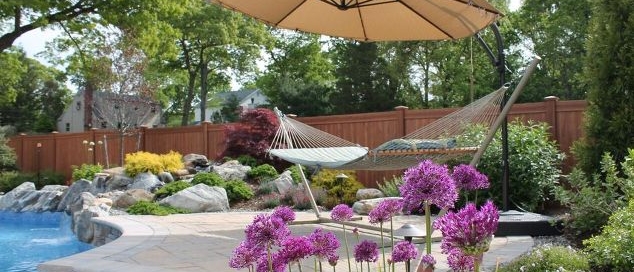
These beautiful purple flowers (seen in the foreground) are planted in the fall and are one of the many plantings that offer robust color in the summer outdoor season and thrive nicely on Long Island and in the northeast. Deck and Patio’s Marc Wiener chose them for this design plan for their height as well as their lovely color contrast.


Design/Build Landscaping: Owning a Piece of Paradise, One Phase at a Time

A backyard oasis can be a major undertaking. Depending on the scope of the project, it isn’t always possible to bring it about all at once. Depending on when you get started, time constraints can limit what is possible to do in one season. Budget can also be a factor. Even local codes may cause temporary roadblocks.

When any these factors frustrate completing your heart’s desire in one season, the answer, of course, is build it in stages. However, in order to ensure that each stage  is in harmony with earlier work, the project’s design requires an extra measure of care.

Phase I should include enough enjoyable elements so that the family can experience a bit of paradise from the get-go. Certainly that was true for the project showcase we’re highlighting here, which was done in two phases.

In addition to a swimming pool and spa, the clients were passionate about having backyard water features in a natural setting that appeared as if Mother Nature did the work — not a landscaping firm. Our Phase I plan included just such backyard delights: a pond, stream and multiple waterfalls that seemed to have always been there.

“In addition to appearing natural, the clients wanted to enjoy beautiful natural sounds and sights from various points in their yard and residence,” says Bill Renter.

“A key decision we made was not to clear-cut their backyard just to make it easy on us to work,” says Bill Renter. “We kept much of the property’s mature oaks, maples and pines in the overall design. In the initial phase, we were also careful to leave sufficient space and access to where the pool and spa would be constructed the following year, taking care that any future construction would not interfere with anything already in place.”

Not only did the homeowners end up with their heart’s desire — owning a piece of paradise that was theirs alone — but the project won Deck and Patio three prestigious awards: Gold, Silver and Bronze from the National Spa and Pool Institute (NSPI).


Backyard Paradise:

Backyard Paradise:

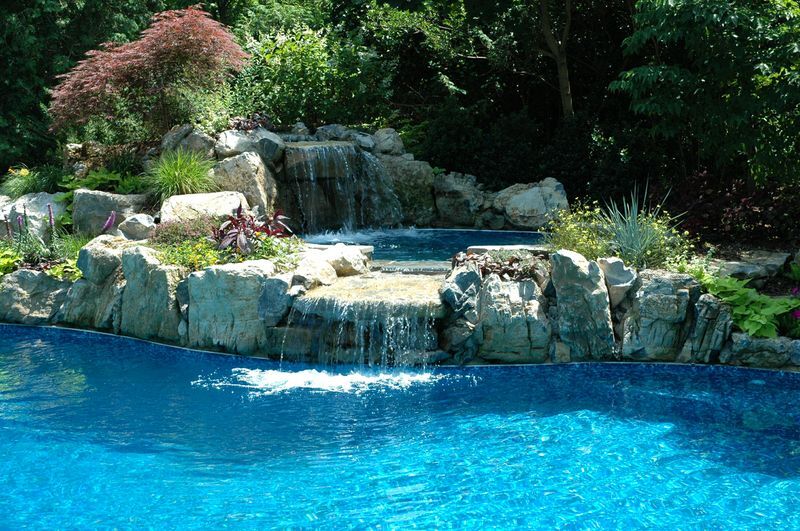
Before any pool was built, Deck and Patio designed the property’s new stream and multiple waterfalls to transverse the rear property line ending in a koi pond. By using the existing topography, we created spills and changes to water direction so they could be easily heard as well as seen from the rear patio and from inside the residence.


Swimming Pool with Spillover Spa:

Swimming Pool with Spillover Spa:

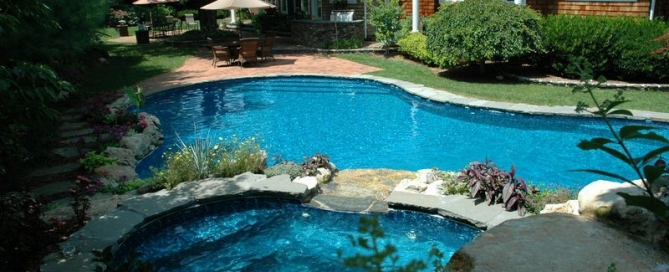
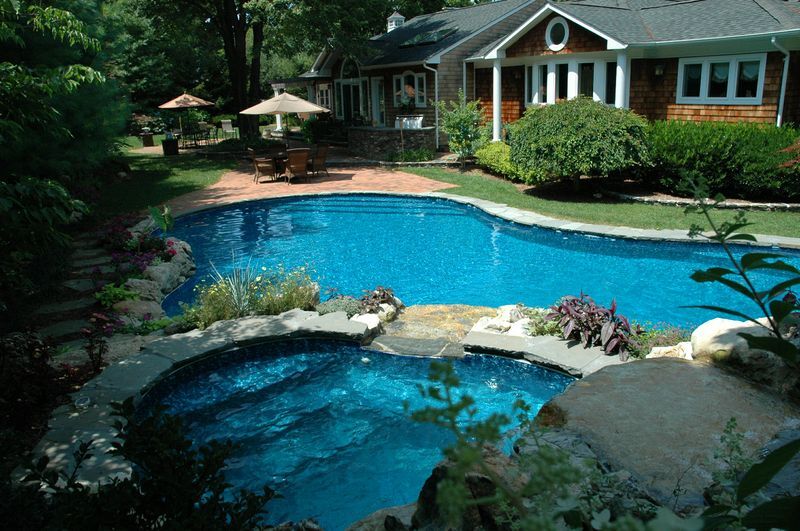
After a year of enjoying their water feature, we installed the pool and spa to complete the backyard renovation. The pool was designed to be “organic” with its natural surroundings and to meet the clients’ desire to have a body of water that would be harmonious with the residence’s existing patio, outdoor kitchen area, waterfall, stream and koi pond.


Spillover Spa:

Spillover Spa:

Built 12 inches above the pool water line, the spa provides a picturesque spillway that intermingles with the surrounding landscape. The clients wanted the spa to be unique and provide some seclusion from the main patio and other viewing angles. A 2-foot-high cascading waterfall into the spa not only offers a gentle massage should you sit under it, but it adds to the overall theme of having pleasant visual and audio effects of moving water.


Landscaping Backyard Oasis:

Landscaping Backyard Oasis:

The pool was also constructed with a moss rock boulder coping which brings the landscape right up to the beam of the pool in a natural setting. Vibration flowers with fragrance that also offer successional color throughout the pool season include a wide variety of perennials, evergreen and deciduous plantings.


Backyard Koi Pond:

Backyard Koi Pond:

The spa was situated by Deck and Patio’s design/build team so the client could view the koi pond and waterfalls while relaxing in the spa.


Water Gardens and Fountainscapes: Beautiful All Year Through

In a previous blog, we showcased Aquascape Inc. Fountainscapes as a great way to experience a water feature in your yard without committing to a larger pond or waterfall system.

You might be wondering, why bring this up now, when winter is about to set in? Actually winter is the point. This blog focuses on just how beautiful water features — of any size — are during winter.

In fact, when the temperature drops, flowing water can turn into art as it crystalizes.

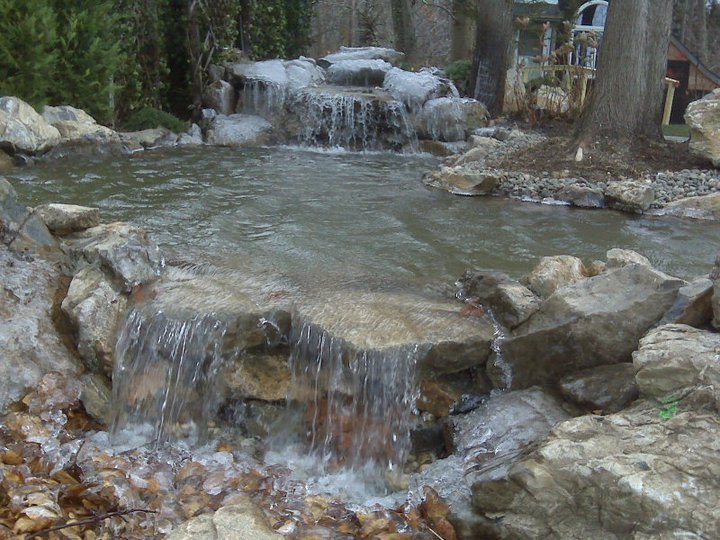
Take for example, the waterfalls we created a few years back on Long Island (NY) as part of a double-pond, stream and multiple-waterfall feature. When months later we stopped by during a strong cold snap, we couldn’t resist taking a photo of the sparkling water falls as they crystalized (first photo below).

In order to give you a fuller picture of the winter beauty that can be part of a water feature, we also posted below three glorious fountainscapes operating in winter.


Water Features in Winter:

Water Features in Winter:

(Long Island/NY) – During a prolonged cold snap, ice forms on the natural stone boulders of this water feature; the water falling over the stones crystalizes into glistening flowing threads — an exquisite sight!


Fountainscapes in Winter:

Fountainscapes in Winter:

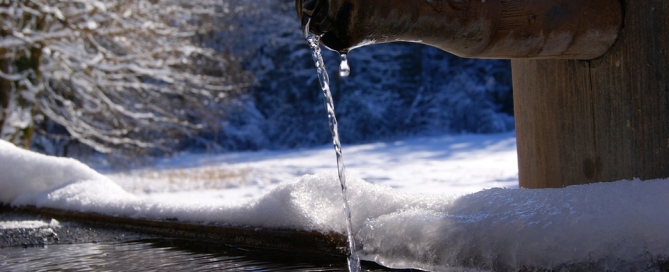
This fountainscape is part of a fountain/miniature pond feature that is arguably even more delightful in winter months than in summer. Note how the small stream of water has become a jeweled thread of ice.


Office Complex Fountainscape

Office Complex Fountainscape


Fountains are not just for backyards. No sir, they are a wonderful indulgence at business offices as well — and as you can see from this winter scene,  clearly a year-round uplift for management and staff.


Winterizing Waterscapes:

Winterizing Waterscapes:

If you do not want the water to freeze, you can choose to winterize your water gardens/waterscapes by running them with heat, which will melt the ice dams. But that is not necessary and might you miss some gorgeous winter scenes.


Fountainscapes:

Fountainscapes:

Of course, winter isn’t the only time of year you’ll appreciate a water feature; even a simple fountain will provide the delightful sound of moving water and a picturesque setting. Photo: Aquascape Inc. Garden Fountain


Fall/Winter Garden Color for Long Island and the Northeast


Did you know that even during winter northeastern gardens can be full of color and interest? Have you spied any of the gorgeous berries blossoming right now around Long Island?

For example, Callicarpa bodinieri, aka “Beautyberry,”  is one of Mother Nature’s delights that thrive locally and is offering lovely color right now (see large feature image above). This ‘beauty’ not only makes a sublime colorful statement in fall, but the berries remain through winter.

To obtain a comprehensive list of what will lift winter doldrums with outdoor color and texture, Deck and Patio spoke with Sandra Vutaggio, Horticulture Consultant at the Cornell Cooperative Extension in Riverhead, NY. She shared a substantial list of choices that will provide either bark interest, colorful berries/seedheads, late-season foliage, flowers or evergreen (see list below).

Some of the listed flora actually fit under multiple categories: Skimmia, for example, offers crimson-red berry interest in fall and winter, and also bright white flowers in spring.

“Deciduous plants like Oakleaf Hydrangea have late season foliage and later offer nice bark in winter,” says Vutaggio.

“All on the list grow well in the northeast, although some can be a little fussy. The Skimmia are an example of those that are a little temperamental and harder to grow. Camellias, which thrive much further south, can be marginally hardy, if planted in a good protected spot where they will get a wind break; then they’ll do fine on Long Island.”

Vutaggio adds that any winter interest in the garden should include some evergreens because they will be the backdrop to anything else that you plant.

Other Tips from Vutaggio:

For perennials — e.g., Hellebore (listed under Flowers) and Rudbeckia (under Seeds): if instead of cutting them down you leave them planted, they provide interest amid snow; the Rudbeckia will provide seed heads which will draw birds to them during winter.

You can still get perennials into the ground right now, but for the larger trees and shrubs, you should wait until early spring until the ground is workable to give them time to grow roots and adjust to your property.

Trees like the Crepe Myrtle, which offer beautiful pink spring flowers and, in fall, finish flowering when the leaves pod up into pretty berries, also provide interesting bark color in winter. More on Crepe Myrtle: https://deckandpatio-uz5hx1gru4.live-website.com/for-fiery-fall-foliage-are-you-barking-up-the-right-trees/

Evergreens of all shapes, sizes and variegation add winter interest. Many junipers turn a bronze/purple in the winter as well. Just google the names on the following list to discover all the wonderful options available for winter color and interest.


Cornell Coop Ext List jpeg


Callicarpa (or Beautyberry):

The beautiful purple berries of the Callicarpa begin in fall and last through winter. Photo: Missouri Botanical Garden


Crepe Myrtle:

Crepe Myrtle:

Thriving on Long Island and the northeast, the Crepe Myrtle brings delicate clusters of pink blossoms in late spring (shown behind waterfall); in fall, it offers bright red-orange leaves and in winter interesting bark. Photo: With Permission: Southern Lagniappe)


Skimmia:

Skimmia:

These evergreen shrubs sport bright green leaves and, in spring, bring vibrant white flowers; in fall, they offer up crimson red fruits (berries) that last all through winter and are especially fine in December. In fact, they make great Christmas or Thanksgiving hostess gifts as they are slow growers that are ideal starting out in pots and containers.  Photo Credit: Musical Linguist at the English language Wikipedia


Fall Pond Maintenance: ‘Netting’ the Leaves Fall Where They May

“Fall foliage will soon be at its peak here on Long Island and many backyard ponds are located near an abundance of these deciduous trees,” says Bill Renter, Deck and Patio’s Outdoor Living Expert. “Even when not immediate to your pond, fallen leaves from nearby trees can make it into your pond. So you’ll want to use a pond net to keep them from accumulating in your stream or pond’s water.”

Indeed, undesirable debris can create a build up of muck on the bottom of your pond and change the water’s pH balance, turning the water murky. For one thing, during winter when the water is colder, the natural bacteria that usually maintains the pond’s balance isn’t active enough to handle it all.

“It’s best to put up the netting before the leaves drop; however, if some leaves have already fallen in, a long-handle pond net can be used to scoop out the debris before covering it with the net,” says Bill.

Dave Kelly at Aquascapes Inc. (St. Charles, IL) adds that you can tent the net, so it doesn’t sag into the pond when it gets weighted with leaves.

Kelly also suggests trimming back and removing dead foliage from aquatic plants to help remove excessive organic material that would otherwise decompose in the water feature.

“When spring comes, you’ll be really happy you took the time to do these few steps,” says Bill. “You’ll have greatly diminished spring pond maintenance, which means you’ll be enjoying a pristine pond sooner — with so much less effort.”


Pond Netting:

Pond Netting:

Pond nets can keep out even the smallest pieces of debris such as falling leaves and pine needles. We recommend netting from Aquascape Inc. (St. Charles, IL) which includes hold-down staples to secure it.


Installing Pond Netting:

Installing Pond Netting:

Aquascape’s Dave Kelly suggests tenting the net so it won’t sag into the pond when its full of leaves.  Photo: Aquascape Inc.


Preparing Backyard for Fall:

Preparing Backyard for Fall:

Along with covering your swimming pool at the end of summer, it is helpful to put up pond netting to collect debris; nets also offer an extra layer of safety for your pond fish by protecting them from birds and other animals.


Pond Maintenance:

Pond Maintenance:

If you take a few precautions in the fall, come spring you will be delighted at how much less maintenance will be required in order to have clear pristine water.


Backyard Water Features in Fall:


Watching leaves moving along a backyard stream is as peaceful an activity as you can find. If there’s only one or two — just sit back and enjoy the scene! But don’t let too many leaves collect in your backyard water features. Photo: Aquascape Inc.


Labor Day Weekend: Blissful Leisure Enjoyed in Busy New York City

Whether it’s a long holiday weekend created for workers, or simply the few scattered hours you squeeze out of a relentless workweek, it’s nice to enjoy some free time in blissful leisure at home.

Location, Location, Location

However, what if your property isn’t located in a pastoral area that allows for quiet time? What if your locality is all hustle-bustle? Such was the case for these Deck and Patio clients. Their home is tightly surrounded by apartment buildings, traffic and noise — in the very heart of a borough of New York City.

In this atmosphere, even adding a pool and patio wouldn’t provide the escape they desired. To create for them a real backyard oasis, we had to block out the noise and oppressive atmosphere.

Solutions, Solutions, Solutions

One of the best ways to screen out noise is a sizable waterfall and the clients opted for one to provide splashing sounds into their new pool. In addition, our clients asked us to build a 12-foot-high concrete block wall. While useful as a noise and environs barrier, a wall can be a bit oppressive in itself.

So the next challenge was to soften the wall’s appearance. First, we planted bamboo around its perimeter. Bamboo can be invasive and we encased the woody grass with concrete blocks to limit its spreading.

Special Feature

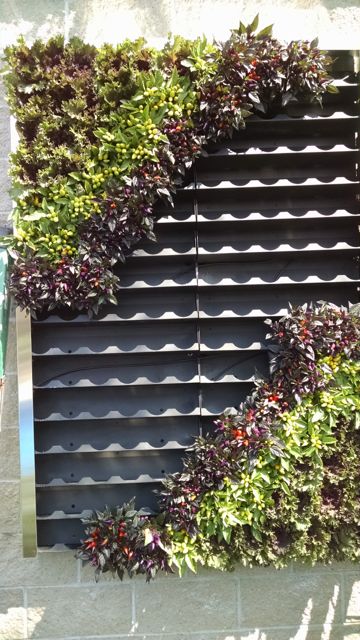
One thing great about interior and exterior walls is they make an ideal canvas. Taking full advantage of the wall, Deck and Patio’s Director of Sales and Landscape Construction, Marc Wiener, designed and supervised the layout of a “living wall” that can hold multiple-sized pots for plants. When completed, the living wall became living art — changing in color and shape almost daily. (For details on living wall, see photos 5, 6, & 7 below.)

The result: the clients may live in a busy part of New York City, but this Labor Day — and every spare moment they can muster— is spent in blissful leisure right in their own backyard.


Backyard Noise Barriers:

Backyard Noise Barriers:

Water cascading over rock into another water pool is a natural sound barrier that is peaceful and soothing to the soul.


 Backyard Refuge:

Backyard Refuge:

The sounds of the waterfalls, the colorful landscaping and the dramatic concrete block wall together give a sense of refuge in this bustling part of one of America’s five largest cities.


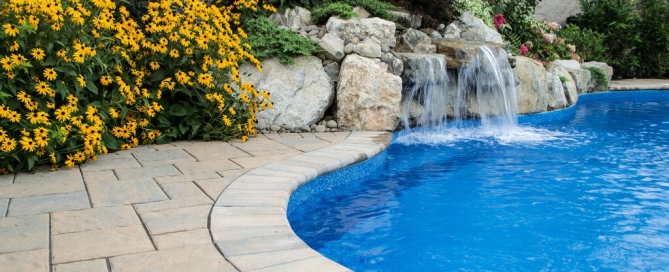
Pool Waterfalls:

Pool Waterfalls:

The free-form vinyl-liner pool includes boulder coping, and a moss rock waterfall with robust plantings that help beautify the wall.


Techo-Bloc Patios:

Techo-Bloc Patios:

The pool’s surrounding patio is made from Techo-Bloc pavers that handsomely complement the 12-foot-high wall and smaller concrete encasement for the bamboo.


Plug n Play Living Walls

Plug n Play Living Walls

‘Plug n Play’ Living Walls: “There are many type of Living Walls; interior and exterior, permanent or seasonal walls, and then there is the ‘Plug n Play’ (manufactured and trademarked by Green Living Technologies, International  or GLTi).” — M.Wiener.


'Plug n Play' Wall

‘Plug n Play’ Wall

“The Plug n Play is very versatile and can be manufactured to accept multiple-sized pots (3” to 12″). Drip irrigation is set up on alternating rows and trickles down to each row below; excess water is either captured or drains. Plants are set on an angle with their holes faced downward so the roots/soil can sap up water via wicking effect.” — M. Wiener.


Outdoor Living Walls:

Outdoor Living Walls:

“The

[living] walls are manufactured in both aluminum and stainless steel. Aluminum walls are extremely light weight and do not require heavy anchor bolts to fasten to walls. Speaking of walls, these units can be fastened to any type of wall; using the right type of fastener for each respective wall type.”  — M. Wiener.


Go to Top