Living Landscapes

Design/Build Landscaping: Owning a Piece of Paradise, One Phase at a Time

A backyard oasis can be a major undertaking. Depending on the scope of the project, it isn’t always possible to bring it about all at once. Depending on when you get started, time constraints can limit what is possible to do in one season. Budget can also be a factor. Even local codes may cause temporary roadblocks.

When any these factors frustrate completing your heart’s desire in one season, the answer, of course, is build it in stages. However, in order to ensure that each stage  is in harmony with earlier work, the project’s design requires an extra measure of care.

Phase I should include enough enjoyable elements so that the family can experience a bit of paradise from the get-go. Certainly that was true for the project showcase we’re highlighting here, which was done in two phases.

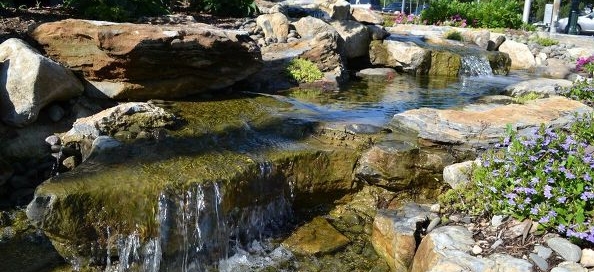
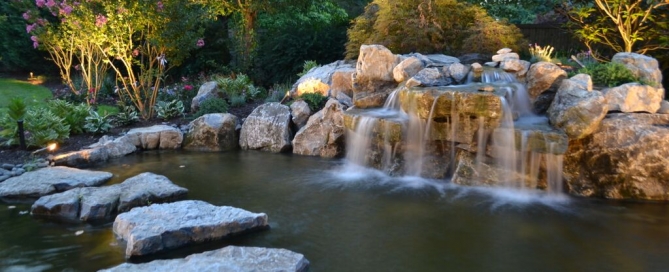
In addition to a swimming pool and spa, the clients were passionate about having backyard water features in a natural setting that appeared as if Mother Nature did the work — not a landscaping firm. Our Phase I plan included just such backyard delights: a pond, stream and multiple waterfalls that seemed to have always been there.

“In addition to appearing natural, the clients wanted to enjoy beautiful natural sounds and sights from various points in their yard and residence,” says Bill Renter.

“A key decision we made was not to clear-cut their backyard just to make it easy on us to work,” says Bill Renter. “We kept much of the property’s mature oaks, maples and pines in the overall design. In the initial phase, we were also careful to leave sufficient space and access to where the pool and spa would be constructed the following year, taking care that any future construction would not interfere with anything already in place.”

Not only did the homeowners end up with their heart’s desire — owning a piece of paradise that was theirs alone — but the project won Deck and Patio three prestigious awards: Gold, Silver and Bronze from the National Spa and Pool Institute (NSPI).


Backyard Paradise:

Backyard Paradise:

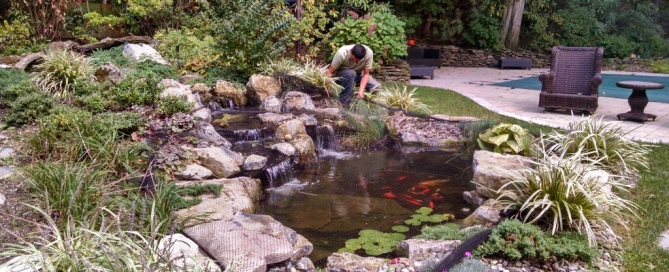
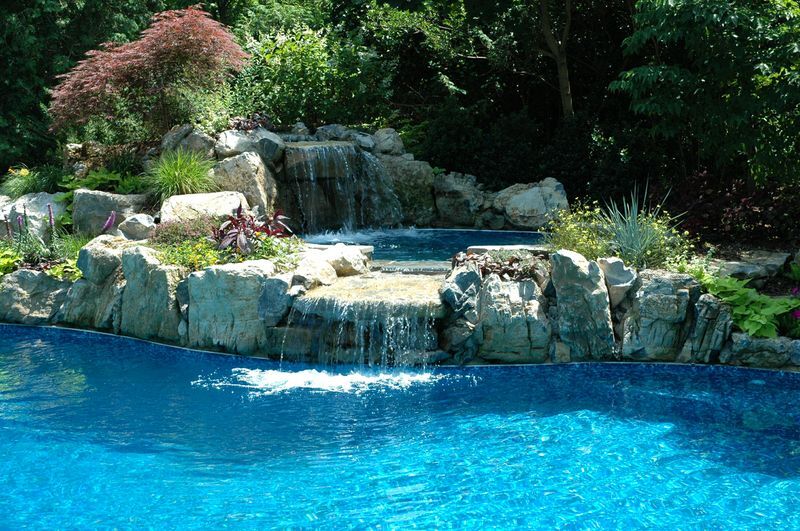
Before any pool was built, Deck and Patio designed the property’s new stream and multiple waterfalls to transverse the rear property line ending in a koi pond. By using the existing topography, we created spills and changes to water direction so they could be easily heard as well as seen from the rear patio and from inside the residence.


Swimming Pool with Spillover Spa:

Swimming Pool with Spillover Spa:

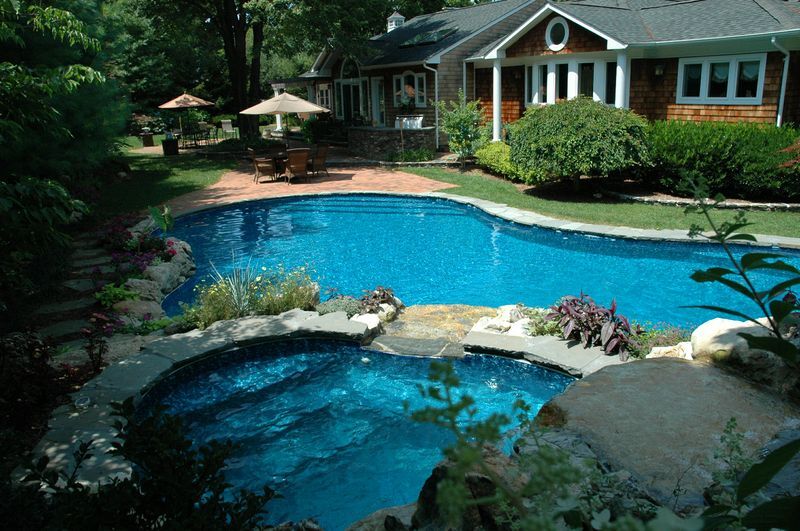
After a year of enjoying their water feature, we installed the pool and spa to complete the backyard renovation. The pool was designed to be “organic” with its natural surroundings and to meet the clients’ desire to have a body of water that would be harmonious with the residence’s existing patio, outdoor kitchen area, waterfall, stream and koi pond.


Spillover Spa:

Spillover Spa:

Built 12 inches above the pool water line, the spa provides a picturesque spillway that intermingles with the surrounding landscape. The clients wanted the spa to be unique and provide some seclusion from the main patio and other viewing angles. A 2-foot-high cascading waterfall into the spa not only offers a gentle massage should you sit under it, but it adds to the overall theme of having pleasant visual and audio effects of moving water.


Landscaping Backyard Oasis:

Landscaping Backyard Oasis:

The pool was also constructed with a moss rock boulder coping which brings the landscape right up to the beam of the pool in a natural setting. Vibration flowers with fragrance that also offer successional color throughout the pool season include a wide variety of perennials, evergreen and deciduous plantings.


Backyard Koi Pond:

Backyard Koi Pond:

The spa was situated by Deck and Patio’s design/build team so the client could view the koi pond and waterfalls while relaxing in the spa.


Trends in Backyard Design: Water Features Are Enjoying a Rippling Effect


In a recent online post on what’s new in outdoor design, hgtv.com (House & Garden/TV) set water-feature-loving hearts a pumping. They have found that one of today’s top outdoor trends in backyard design is the backyard water feature.

In our experience at Deck and Patio, there are many reasons for this popularity. In addition to water features providing an attractive focal point all year through — be it a simple easy-to-install single portable fountain, or a gorgeous deep natural swimming pond complete with waterfalls and streams — the sound and sight of moving water is instantly soothing. And when created on a large-enough scale, such a feature can even block out unwanted noise.

Another major factor in their popularity are the many options available. Whatever one’s taste, there’s a feature to match it — from historic rustic to contemporary and sleek.

That brings us to perhaps the biggest reason for the growth in this backyard trend:

                      Any budget can absorb it!


Bubbling Fountains

Relatively inexpensive, bubbling rocks, single urns, and multiple rock fountains bring the sounds and sight of moving water to your backyard effortlessly.


Garden Fountain (Long Island/NY)

Garden Fountain (Long Island/NY)

When Deck and Patio’s designer was completing this garden, he noticed that “something was missing.” The clients agreed that a modest water fountain would add more life and provide a focal point in the garden. The “stacked stone urn” design they chose is the smallest kit available from Aquascape Inc. (32” tall), which suited their style and was the perfect scale for the garden.


Bubbling Rock Water Features (Brooklyn/NY):

Bubbling Rock Water Features (Brooklyn/NY):

While this bubbling rock is part of a larger rainwater harvesting/pond project (Brooklyn/NY), it can be installed on its own to provide the sight and sounds of moving water. When sitting out on their patio, the fountain offers the homeowners a serene focal point that also helps irrigate the garden.


Sheet Waterfalls

Sheet waterfalls are a popular choice for people who enjoy a sleek modern look. Also called Sheer Descent, these waterfalls provide a particular soothing sound unique to their design.

Outdoor Bar with Waterfalls (Long Island/NY):

Outdoor Bar with Waterfalls (Long Island/NY):

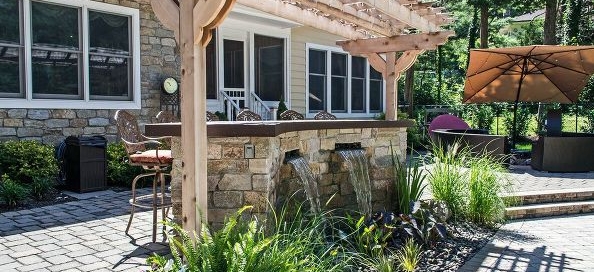
Space was at a premium in this yard and the usual type of large water feature (e.g., pond fed by streams with waterfalls etc.) wouldn’t have fit. The Deck and Patio designer suggested adding two sheer descent waterfalls flowing out of the new stone bar we were constructing for them. The flowing water is collected underground and re-circulated, eliminating the usual above-ground presence of a pond.


Waterfalls/Ponds and Water Gardens

Cascading water in our backyards offer more than beauty. They can help eliminate noise problems.

Waterfalls (Long Island/NY):

Waterfalls (Long Island/NY):

These clients had a backyard noise problem. Their home is located close to a very busy street and the solution we came up with is for this lovely pondless waterfall. The noise is completely eliminated by the flowing water cascading over imported moss rock boulders. It’s beautiful to look at whether you are lounging on the patio or taking a swim in the pool — and when outdoors, the family feels like they are far away from the hubbub of daily life.


Ponds and Water Gardens (Long Island/NY):

Ponds and Water Gardens (Long Island/NY):

Backyard ponds and water gardens have been growing in popularity for some time; recent trends are for adding aquatic plants. These plants are not just beautiful to look at. Carefully chosen, they absorb nutrients an pollutants and help purify the pond. Along with the water, these plants become a magnet for local birds who come to bathe and rest on or near the plants. In this project, we added ornamental grasses and lily pads inside the pond surrounded by flowering perennials for color and charm.


Water Features are for All Seasons

When our clients ask our experts if they should close down their ponds or fountains for the winter, our answer is frequently, No! Most ponds — even stocked with koi — can operate during winter.

Fountainscapes (Long Island/NY):

Fountainscapes (Long Island/NY):

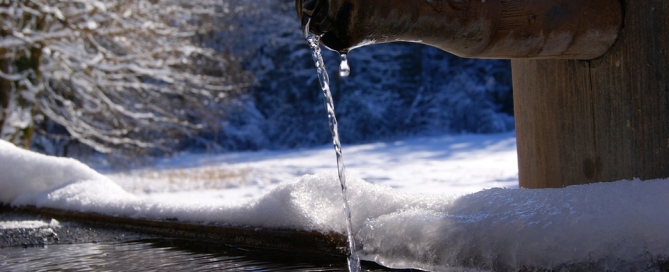
Crafted in delightful old-world charm, this fountainscape is part of a fountain/miniature pond feature that is as peaceful in winter months as it is in summer. Note how the small stream of water becomes a jeweled thread of ice during winter’s icy blasts.


Natural Swimming Ponds

Being able to swim in your own backyard pristine natural pond is perhaps the ultimate in backyard water features. The best natural swimming ponds are built big and deep enough to allow for snorkeling and provide ample room to swim.


Natural Swimming Ponds (Long Island/NY):

Natural Swimming Ponds (Long Island/NY):

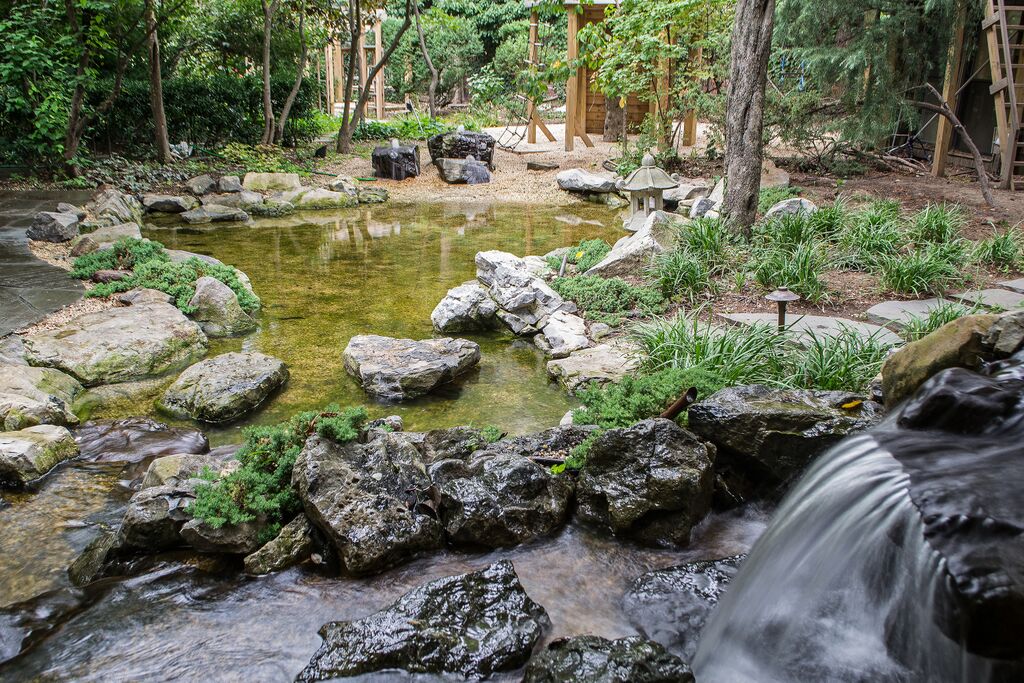
It requires expertise to create a natural swimming  environment and be able to enjoy it much like we did swimming holes in years past. It takes, for example, the correct underlayment, liner, Biofalls (Aquascape Inc.), bog filtration, as well as the ideal water plants etc. Photo: Courtesy of Aquascape Inc.


Rainwater Harvesting Incentive Programs: Savings From a Rainy Day

Because water is so important to our every day lives, improving and maintaining water quality is our passion at Deck and Patio. In fact, we have a special division — Rainwater Harvesting Group — dedicated to installing rainwater collection systems that alleviate demand on municipal systems, reduce water bills and beautify and enhance landscaping and properties.

In addition to saving on water bills, fortunate residents in other parts of the United States, who have installed rainwater harvesting collection systems (alas not New York as of this writing), can take advantage of state and/or local rebates — the amount of the rebate being frequently determined by the type and size of the harvesting system installed (i.e., barrel collection or pump driven).

One city — Austin, TX — has an excellent rebate program. Granted, Texas has suffered through five straight years of droughts until last year’s spring rains were finally sufficient, so saving rainwater there is a high priority. However, other areas in the country, not so plagued by droughts, offer similar water rebates through their own state and local initiatives.

To find out how such programs might benefit Long Island, we spoke with Nick Menchyk, Assistant Professor (Urban Horticulture & Design) at SUNY Farmingdale.

“On the east coast, we typically get plenty of rain. However, any time we can harvest and use rainwater for irrigating our landscape — as opposed to pulling it from our aquifers — is going to be beneficial. Where government programs around the country exist, these programs have worked very well, and we should look at this at the local level here on Long Island,” says Professor Menchyk.

He adds that in California, for example, they offered rebates to remove turfgrass in favor of drought tolerant landscapes and that state funding ran out of money because so many people jumped at it.

“So any time you can encourage people to use that rain barrel or an in-ground system to collect rainwater is bound to be effective.”

While he does not consider himself an expert in rainwater harvesting and rain gardens, Professor Menchyk is convinced that it’s only a matter of time when the greater eastern seaboard will be looking to how we irrigate, as well as which plants work well in droughts and in rain gardens.

“Whether we like it or not, the future holds limitations in the amount of water we use. Rainwater harvesting is a way we can be responsible stewards of our environment now. We have such a unique area on Long Island. Along the coast, we are less than 11 feet from ground water. Any way we can capture water from impervious parts of our landscapes — and prevent it from leaving our property — is going to reduce the number of pollutants and nutrients getting into our lakes, streams, oceans and potentially into the ground water.”

A special thanks to Professor Menchyk. As an additional note: While harvesting rainwater is not a new idea, rebates for installing such systems are still very new. Deck and Patio’s research shows that only the following states, either through state or local municipalities, offer incentives for rainwater harvesting at this time: Arizona, California, Colorado, Florida, Illinois, Indiana, Maryland, Minnesota, Nevada, New Mexico, Oregon, Texas, Virginia, Washington. and Washington D.C.


Capturing Rainwater Runoff:

Capturing Rainwater Runoff:

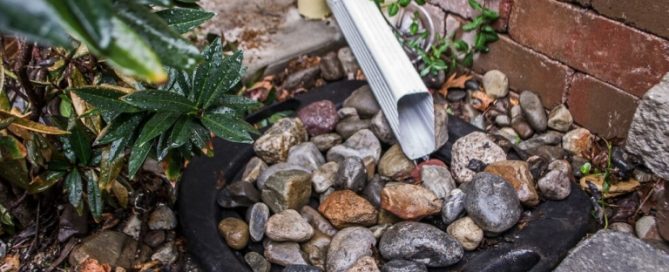
The average homeowner uses about 3,000 gallons of water a week, 70% of which is for irrigation — or water that doesn’t need to be treated. For this project, four downspouts collects about three quarters of the clients’ roof runoff, which goes through containers with filters to screen out twigs and small debris before sending the rainwater down into the reservoir for reuse in irrigation and to top off a backyard pond when needed.


Healthy Eco-Systems:

Healthy Eco-Systems:

Deck and Patio frequently uses rainwater harvesting as part of a complete, self-sustaining eco-system. This water feature includes a stream and multiple waterfalls — all recirculated through the same Aquascape RainXchange water collection system. City water is not used. The feature attracts desirable wildlife such as frogs, butterflies, birds etc. creating a delightful wildlife refuge.


Rainwater Harvesting at Huntington Railroad Station:

Rainwater Harvesting at Huntington Railroad Station:

Here is a great example of government and business working hand-in-hand to beautify the landscape while capturing rainwater for irrigation. Where once was only a dirt path from the sidewalk to the train parking lot, permeable pavers allow easy walking (arrow area pavers) while capturing and filtering rainwater for reuse. The pavers used are Techo-Bloc Victorien Permeable Pavers.


Water Features:

Water Features:

All rainwater harvesting systems need some way to aerate the water. In this case, a beautiful water feature with waterfalls provides this service. The waterfall aerates the water — or oxygenates it — and the right water plants will absorb nutrients and pollutants  to help purify the water. All together, the gravel, under-ground liner, and plants create a self-sustaining rainwater harvesting garden. The area is a magnet for local birds who come to bathe and drink.


US Green LEED Grants:

US Green LEED Grants:

These Brooklyn clients have a four-story walk-up and they wanted to collect all the water that comes off their roof. In addition to the obvious “green” aspects, they hoped to take advantage of certification from the U.S. Green Building Council’s LEED (Leadership in Energy & Environmental Design) program. According to the Council, certification may allow property owners to qualify for a host of incentives like tax rebates and zoning allowances. Not to mention they retain higher property values.


Landscaping Trends 2024: The Benefits of Harvesting Rainwater

Updated 1-4-24

Living in the northeast, we don’t usually experience a shortage of rain. So why bother harvesting rainwater you might ask? 

Major Benefits to Rainwater Harvesting

Major Benefits to Rainwater Harvesting

As the Washington Post reminded us this week in their report, capturing rainwater isn’t just about saving water for potential droughts. Capturing rainwater — and using it for tasks such as watering the garden or landscape, topping off water features, washing the car, etc. — has some major benefits that should be very dear to the hearts of Long Islanders.

When rainwater rushes along our roads and byways into sewers, it picks up contaminants along the way. By the time it makes it to our waterways, The rainwater is not healthy and is deposited where swimming, surfing, boating and other water sports are a passion for many. 

But when homeowners capture and use rainwater, it stops a lot of that runoff from flooding or carrying pollutants into natural bodies of water, says the Washington Post. This helps avoid flooding as well.’


Average Homeowner Water Use


Rainwater will not soak into asphalt or concrete.

Rainwater will not soak into asphalt or concrete.

Did you know that according to statistics the “average” homeowner uses approximately 3,000 gallons of water weekly with about 70% used outdoors?

And have you considered that freely available rainwater does not soak into asphalt and concrete for us to capture, but, instead, flows away, picking up contaminants as it goes, on into over-burdened sewer systems (and hence on into our area waterways)?

Well, this runoff is not just water over the dam, if it highlights how valuable rainwater is to us as an, albeit, neglected, but available precious resource. The trick is: how to keep the rain where it falls to be reused.


Rain Runoff: Instead of being just runoff like pictured here, the trick is to capture rain where it falls to be reused.

Rain Runoff: Instead of being just runoff as pictured here, the trick is to capture rain where it falls to be reused.


# 3 insertHarvesting rainwater is not a new idea. People have been collecting it for generations, frequently storing it in rain barrels.

And this is still a viable method. But there’s a lot more that can be done with falling rain than saving small amounts in unattractive above-ground  containers.


Healthy Ecosystems:

Healthy Ecosystems:

Through our Rainwater Harvesting Group, Deck and Patio specializes in installing rainwater harvesting systems that capture rainwater as part of a complete self-sustaining eco-system.


Beautiful Backyard Water Features:

Beautiful Backyard Water Features:

Captured, filtered and recirculated rainwater, in sufficient amounts to supply attractive water features, work together with carefully chosen plants, fish, rocks and gravel, to maintain a balanced system for long-term sustainability.


Rainwater Harvesting:

Rainwater Harvesting:

Using Aquascape’s RainXchange, and sometimes permeable pavers as pictured here, today’s rainwater harvesting systems capture sufficient rainwater to also wash your car and/or hose down the deck and patio. And when you consider that  local Long island water companies frequently charge an incremental rate, based on the amount of water used, capturing all the non-ingestive water you need from rainfall, the lower your rate will be.


Harvesting Rainwater Roof Runoff:

Harvesting Rainwater Roof Runoff:

For this project, four downspouts collects about three quarters of the clients’ roof runoff, which goes through containers with filters to screen out twigs and small debris before sending the rainwater down into the reservoir for reuse in irrigation and to top off a backyard pond when needed.


Backyard Wildlife Refuge:

Backyard Wildlife Refuge:

This water feature by Deck and Patio includes a stream and multiple waterfalls — all recirculated through the same RainXchange water collection system. City water is not used. Such a feature attracts desirable wildlife such as frogs, butterflies, birds etc. creating one’s own wildlife refuge.


Water Gardens and Fountainscapes: Beautiful All Year Through

In a previous blog, we showcased Aquascape Inc. Fountainscapes as a great way to experience a water feature in your yard without committing to a larger pond or waterfall system.

You might be wondering, why bring this up now, when winter is about to set in? Actually winter is the point. This blog focuses on just how beautiful water features — of any size — are during winter.

In fact, when the temperature drops, flowing water can turn into art as it crystalizes.

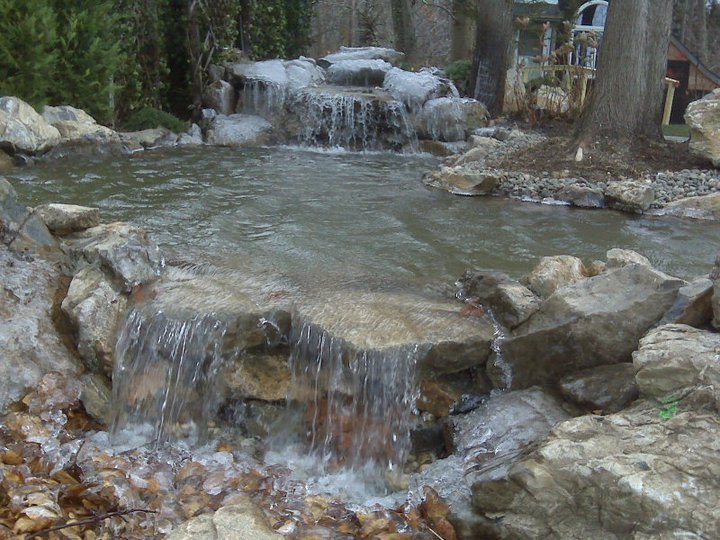
Take for example, the waterfalls we created a few years back on Long Island (NY) as part of a double-pond, stream and multiple-waterfall feature. When months later we stopped by during a strong cold snap, we couldn’t resist taking a photo of the sparkling water falls as they crystalized (first photo below).

In order to give you a fuller picture of the winter beauty that can be part of a water feature, we also posted below three glorious fountainscapes operating in winter.


Water Features in Winter:

Water Features in Winter:

(Long Island/NY) – During a prolonged cold snap, ice forms on the natural stone boulders of this water feature; the water falling over the stones crystalizes into glistening flowing threads — an exquisite sight!


Fountainscapes in Winter:

Fountainscapes in Winter:

This fountainscape is part of a fountain/miniature pond feature that is arguably even more delightful in winter months than in summer. Note how the small stream of water has become a jeweled thread of ice.


Office Complex Fountainscape

Office Complex Fountainscape


Fountains are not just for backyards. No sir, they are a wonderful indulgence at business offices as well — and as you can see from this winter scene,  clearly a year-round uplift for management and staff.


Winterizing Waterscapes:

Winterizing Waterscapes:

If you do not want the water to freeze, you can choose to winterize your water gardens/waterscapes by running them with heat, which will melt the ice dams. But that is not necessary and might you miss some gorgeous winter scenes.


Fountainscapes:

Fountainscapes:

Of course, winter isn’t the only time of year you’ll appreciate a water feature; even a simple fountain will provide the delightful sound of moving water and a picturesque setting. Photo: Aquascape Inc. Garden Fountain


Rainwater Harvesting: Because Open Space Is a Terrible Thing to Waste

Rainwater Harvesting (Long Island/NY): The Aquascape ‘green’ RainExchange process combines a decorative water feature with a completely sub-surface collection system -- thereby creating a beautiful backyard oasis that is very eco-friendly.

Rainwater Harvesting (Long Island/NY): The Aquascape ‘green’ RainExchange process for this feature combines a decorative water feature with a completely sub-surface collection system — thereby creating a beautiful backyard oasis that is very eco-friendly.

Our pond experts at Deck and Patio — and a growing number of new clients — want a pond and waterfall less as a lovely background filler and more for the opportunity it offers to invigorate the surrounding ecosystem.

Indeed, the sound and look of moving water brings any yard or business property a restful escape for rejuvenation, which in and of itself is a great idea. But ponds and pond-less water features also provide an opportunity for rainwater harvesting, thereby saving water and aiding the local ecology.

As certified installers of Aquascape Inc. (St. Charles, IL), our water systems and water garden products are both technologically and biologically efficient. Using high efficiency pumps, skimmers, biological filters, as well as gravel beds, and water plants, these contribute to creating a total natural biological system around ponds and waterfalls that can be replenished and maintained entirely through rainfall.

Such rainwater harvesting systems will support the beautiful water feature you install — fountains, waterfalls, ponds, streams — by ecologically collecting and reusing rainwater. This captured water can also replenish the surrounding landscape, wash a car, rinse down a deck or patio, etc., and is especially helpful during droughts.

Rainwater Harvesting Reservoirs

“Totally below ground, a rainwater harvesting reservoir acts as a ‘green’ maintenance-free source for the water feature that can run from March through December, 24-7,” says Deck and Patio’s Outdoor Living Expert, Bill Renter. “City water is not used. The water is harvested totally from rainfall on the roof of the house or through permeable pavers. Gravity alone collects it into pipes and moves it along.”


Pondless Reservoir (Long Island/NY):

Pondless Reservoir (Long Island/NY):

(Above) The “green” pondless reservoir system we installed at the end of the stream captures the water and recirculates it, making it a green system. Plus we designed it to seemingly disappear into the gravel instead of looking as if it’s being collected. We planted dense and durable evergreens such as Procumbent Juniper that are very low maintenance and spread nicely. For color we used Begonias, Coleus, and flowering plants like Astilbe.


Beautiful Pondscape (Long Island/NY):

Beautiful Pondscape (Long Island/NY):

Along with waterfalls, stream and pond, for a healthy ecosystem, it is essential to choose the right stones and gravel (which provide the correct ph value for the fish and plants). A beautiful Japanese maple shades this pondscape’s bridge; bright red geraniums add a strong burst of color (bottom right of photo).


Permeable Pavers for Water Purification and Collection

Permeable pavers over gravel and a rubber liner allow easy walking while capturing and filtering rainwater for reuse. The gravel underneath the pavers filters the collected water runoff before it is sent to any reservoir installed at the end of a stream/water feature.

The system we use for this is a RainXchange Harvesting System, produced by Aquascapes Inc. In addition to using the water collected by the pavers, the system includes an auxiliary pump that can be connected to any irrigation system including a roof runoff system.

In collaboration with the Town of Huntington, we did such a project at our local Train Station:


Rainwater Harvesting Water Feature (Huntington Station/NY):

Rainwater Harvesting Water Feature (Huntington Station/NY):

This water feature is not just for aesthetics, but it is highly functional. Its waterfall aerates the water — or oxygenates it. The water plants absorb nutrients and pollutants to help purify the water. All together, the gravel, liner, and plants create a self-sustaining rainwater harvesting garden. The station area is now a magnet for local birds who come here to bathe and drink.


Rainwater Harvesting (Brooklyn/NY):

Rainwater Harvesting (Brooklyn/NY):

100% of this client’s irrigation water comes from what falls from the roof and onto the patio. In this first of 3 photos, you see how rainwater is collected from the roof. At any given time, there is now about 1,000 gallons of water in the reservoir and about an equal amount of water underneath their permeable pavers.


Rainwater Harvesting (Brooklyn/NY):

Rainwater Harvesting (Brooklyn/NY):

Voids between the pavers are filled with crushed stone; when rain passes through the pavers’ joint spaces, it flows down into an underneath layer of bluestone gravel and about an inch of crushed stone which filters the water. Under all that, a liner captures the rainwater, and it is pitched so it pushes water towards the underground reservoir.


Rainwater Harvesting (Brooklyn/NY):

Rainwater Harvesting (Brooklyn/NY):

For this project, we also installed an automatic valve; when the water gets low in their new pond, waterfalls or stream, water in the irrigation system flows in and replenishes it.


Infinity Pool Project in Cove Neck, Long Island (NY)

Swimming at the edge of your world


Some say the first infinity pool was built at France’s Palace of Versailles, where from, say, one of the palace’s gardens, the eye is enticed across an expansive “infinite” pool of water up to the panoramic King’s palace.

Now perhaps it’s a breathtaking sunset that you want to draw the eye to on your property, or a gorgeous flower garden, or scenic bay. Indeed, in today’s project showcase, it was their property’s spectacular views of Oyster Bay on Long Island’s North Shore that drew these Deck and Patio clients to such a pool.

Infinity Pools

Man-made infinity (aka vanishing edge) pools expand the serenity of a backyard pool by drawing the eye to some other exquisite scene, thereby substantially increasing the restful beauty of any backyard retreat.  However, the finished results belie their underpinnings. These pools — no matter which focal point you are drawing the eye to — require experts to design and install it.

“Vanishing edge pools are an optical illusion that suggest the water is vanishing out of the back edge of the pool,” says our outdoor living expert, Bill Renter. “Nothing is, of course, vanishing in a vanishing edge pool. The water is actually clinging to a recess in the pool wall which then drops into a catch pool below. And while this sounds simple enough, it requires a good deal of mastery to design it correctly. An undersized catch pool can almost never be corrected.”

Bill explains that if the catch pool or basin isn’t large enough there won’t be enough water returning to the main pool and can cause serious problems. Insufficient water may also be a real disappointment, since many like the idea of an infinity pool precisely because the water they swim in will never be stagnant, but will be continually recycled through the pool.

The key, then, is to make sure you deal with experts. And what you get for your effort, is — dare we say it — fit for a king.


___________

Additional note on catch basins: If the catch pool or basin isn’t large enough there won’t be enough water returning to the main pool and the catch pool will run dry. That can trigger huge water bills because it would have to be constantly refilled to compensate for not having enough room to store water. In addition,  during rain falls, the basin could be overwhelmed, leading to it overflowing, or eroding or liquefying the soil behind it.

___________


Infinity Pool (Cove Neck/NY): Depending on where you are in this vanishing edge pool will determine which extraordinary vista your eyes are drawn to.

Infinity Pool (Cove Neck/NY): Depending on where you are in this vanishing edge pool will determine which extraordinary vista your eyes are drawn to.


Pool Landscaping (Cove Neck/NY): Landscaping can play a key role in enhancing the experience of an infinity pool.

Pool Landscaping (Cove Neck/NY): Landscaping can play a key role in enhancing the experience of an infinity pool.


Infinity Pool Catch Basin (Cove Neck/NY): One reason people love infinity pools is that the water is never stagnant but flows into a catch pool and is recycled.

Infinity Pool Catch Basin (Cove Neck/NY): One reason people love infinity pools is that the water is never stagnant but flows into a catch pool and is recycled.


Vanishing Edge Pool (Cove Neck/NY): In addition to the recycled pool water, for this project, a custom “spillover” spa offers healthy aeration to the pool water.

Vanishing Edge Pool (Cove Neck/NY): In addition to the recycled pool water, for this project, a custom “spillover” spa offers healthy aeration to the pool water.


Pool Landscaping (Cove Neck/NY): Everywhere you look in this completed backyard project there is a lovely scene worth pausing for.

Pool Landscaping (Cove Neck/NY): Everywhere you look in this completed backyard project there is a lovely scene worth pausing for.


Infinity Pool and Spa (Cove Neck/NY): It’s wonderful when you can’t decide which is the best seat in the ‘house’ — the pool or the spa!

Infinity Pool and Spa (Cove Neck/NY):: It’s wonderful when you can’t decide which is the best seat in the ‘house’ — the pool or the spa!


Vanishing Edge Pool (Cove Neck/NY): You don’t have to be a descendant of Louis IV to swim in royal waters.

Vanishing Edge Pool (Cove Neck/NY): You don’t have to be a descendant of Louis IV to swim in royal waters.


Aquascape Water Gardens: The Appeal of Koi Ponds

Pond lovers are familiar with Aquascape as the leading water garden innovator in North America, so we were more than flattered when, in early May, our own Bill Renter was invited to do a guest blog on koi ponds for their web site. In case you missed it, we’re sharing it today.

Koi Ponds – For the Child in Us All  

By Bill Renter, Outdoor Living Expert

“Growing up, I was what they call today a ‘free-range’ kid. Like most children back then, I was free to explore the outdoors on my own and interact with nature.

Things are different today. Parents and child caretakers are far more cautious about letting children wander on their own. This is one reason, I believe, why koi ponds have skyrocketed in appeal. Through them, Mother Nature’s best experiences are brought right to our own backyards.

For sure, kids love watching and feeding colorful pond fish. Koi are gentle creatures that will swim right up to be fed, accepting food directly from the hand. And since it’s better to feed them in small amounts throughout the day, pretty much any time the kids are free, it’s a good time for the koi, too.

Backyard ponds attract other wildlife that children love: frogs, salamanders — basically any amphibian that lay their eggs in or near water. Plus birds will flock there, including song birds.

However, predatory birds like heron may be attracted to the koi. There are steps you can take to dissuade them, like netting, decoys, and electronic scarecrows with sensors that spray water when they catch movement. Also, thoughtful landscaping can provide protection as herons prefer an unobstructed path to wade into the water. And from the outset, having the right depth of water in the pond (no less than 24″) is key to keeping heron at bay.

My favorite koi ponds are the larger ‘swimming ponds.’ Children can snorkel in these and get up face to face with the fish. For swimming, you want clean water, so I’d recommend not overstocking your pond. You don’t want more fish waste than can be reasonably absorbed by aquatic plants and the pond’s bog filtration system.

Now while there are a few things to consider, with a little care, koi ponds are ideal to bring out the child in us all. Even today, when a pond is large enough, I can’t resist a swim.

So I say … go ahead … be a ‘helicopter’ parent or grandparent, and hover over the kids. With a backyard koi pond, kids aren’t missing out on much at all.”


Pond Fish:

Pond Fish:

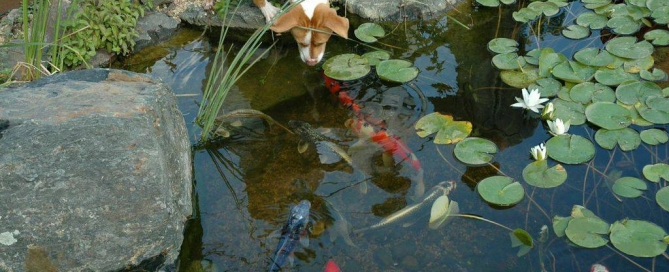
Koi are gentle creatures that will swim right up to be fed, accepting food directly from the hand.


Good Pond Design:

Good Pond Design:

Well designed landscaping can provide protection as herons prefer an unobstructed path to wade into the water.


Swimming Ponds:

Swimming Ponds:

Another blog post on Aquascape’s website, titled: “Growing Up Around a Pond,” included this photo of her son encouraging a friend to join him in the pond. Photo: Courtesy of Aquascape Inc.


Useful Pond Koi:

Useful Pond Koi:

Koi is a healthy part of this pond’s natural ecosystem; in this Deck and Patio-designed pond, the koi have lots of room to hide as well as swim. There are also plenty of rock overhangs to discourage predators.


Fall Pond Maintenance: ‘Netting’ the Leaves Fall Where They May

“Fall foliage will soon be at its peak here on Long Island and many backyard ponds are located near an abundance of these deciduous trees,” says Bill Renter, Deck and Patio’s Outdoor Living Expert. “Even when not immediate to your pond, fallen leaves from nearby trees can make it into your pond. So you’ll want to use a pond net to keep them from accumulating in your stream or pond’s water.”

Indeed, undesirable debris can create a build up of muck on the bottom of your pond and change the water’s pH balance, turning the water murky. For one thing, during winter when the water is colder, the natural bacteria that usually maintains the pond’s balance isn’t active enough to handle it all.

“It’s best to put up the netting before the leaves drop; however, if some leaves have already fallen in, a long-handle pond net can be used to scoop out the debris before covering it with the net,” says Bill.

Dave Kelly at Aquascapes Inc. (St. Charles, IL) adds that you can tent the net, so it doesn’t sag into the pond when it gets weighted with leaves.

Kelly also suggests trimming back and removing dead foliage from aquatic plants to help remove excessive organic material that would otherwise decompose in the water feature.

“When spring comes, you’ll be really happy you took the time to do these few steps,” says Bill. “You’ll have greatly diminished spring pond maintenance, which means you’ll be enjoying a pristine pond sooner — with so much less effort.”


Pond Netting:

Pond Netting:

Pond nets can keep out even the smallest pieces of debris such as falling leaves and pine needles. We recommend netting from Aquascape Inc. (St. Charles, IL) which includes hold-down staples to secure it.


Installing Pond Netting:

Installing Pond Netting:

Aquascape’s Dave Kelly suggests tenting the net so it won’t sag into the pond when its full of leaves.  Photo: Aquascape Inc.


Preparing Backyard for Fall:

Preparing Backyard for Fall:

Along with covering your swimming pool at the end of summer, it is helpful to put up pond netting to collect debris; nets also offer an extra layer of safety for your pond fish by protecting them from birds and other animals.


Pond Maintenance:

Pond Maintenance:

If you take a few precautions in the fall, come spring you will be delighted at how much less maintenance will be required in order to have clear pristine water.


Backyard Water Features in Fall:


Watching leaves moving along a backyard stream is as peaceful an activity as you can find. If there’s only one or two — just sit back and enjoy the scene! But don’t let too many leaves collect in your backyard water features. Photo: Aquascape Inc.


2015 APSP Int’l Awards: Deck and Patio Sweeps Water Features Category

“When the voice of the pool and spa industry — The Association of Pool & Spa Professionals (APSP) — awards your company all its top honors in a category, it is an amazing achievement,” says Bill Renter, owner of Deck and Patio.

“Indeed, winning Gold, Silver and Bronze for our water features  — and to be the only company to win in this category — not only makes us proud, but it is a testimony to the wonderful team we have at Deck and Patio.

Having done over 300 ponds/waterfalls on Long Island alone, Deck and Patio is known locally as experts in this field. “However, when you receive the only Gold medal awarded to a water feature in an international competition, you admit to yourself, ‘Yes, we are doing things right.”

Bill adds that APSP is a wonderful gathering place for industry professionals to learn from each other.

“I am continually amazed at what some of our fellow professionals come up with. This year, I noted sleek designs for pools, for example. On the surface they seemed clean and simple, but they required a high degree of engineering expertise.”

One such design was for a perimeter-overflow swimming pool where the water level was the same height as the patio.

“Usually, the water is six inches below its surroundings,” says Renter. “An overflow means there’s actually a little channel around the perimeter catching the water. These pools create lovely reflections of their surroundings, as well as providing a clean modern look. Again, they are extremely complicated, but they look very simple. This really impressed me.”


Deck and Patio’s APSP Gold Award (Islip, NY):

Deck and Patio’s APSP Gold Award (Islip, NY):

The waterfalls we created to flow over rocks in this water feature are not just for beauty; they aerate the 23  by 16,  2-foot-deep pond, keeping it from becoming stagnant. In addition to aquatic plants in and around the pond, the landscaping included bright plantings. We added colorful koi, plus the pond attracts other desirable wildlife for a blissful backyard escape that is a delight for all the senses.


Deck and Patio’s APSP Gold Award (Islip, NY):

Deck and Patio’s APSP Gold Award (Islip, NY):

We also added stepping stones across this same pond, which make it possible to go from their new deck out into the yard — in a way that contributes to the overall restful experience of the water feature. The stones’ irregularity and careful placement create an element of what the ancient Japanese called the ‘contemplative world.’


Deck and Patio’s APSP Silver Award (Brooklyn, NY):

Deck and Patio’s APSP Silver Award (Brooklyn, NY):

Even though they live in a bustling, high-traffic part of New York City, this client wanted her children to experience the same interaction with nature that she had as a child. For them we designed/built a complete backyard playground oasis: a swimming pond with a beach-style entry and a water feature with three waterfalls.


 Deck and Patio’s APSP Silver Award (Brooklyn, NY):

Deck and Patio’s APSP Silver Award (Brooklyn, NY):

Instead of using any chemicals, to keep the pond healthy through a natural eco-system, we used all Aquascape Inc. equipment and components. We also constructed the shallow pond as a deeper koi pond with boulders that are covered with fabric and gravel; when the children are older, this can be removed, leaving only the liner, to create a full-sized koi pond providing an entirely different experience for the children.


Deck and Patio’s APSP Bronze Award (Fort Salonga, NY):

Deck and Patio’s APSP Bronze Award (Fort Salonga, NY):

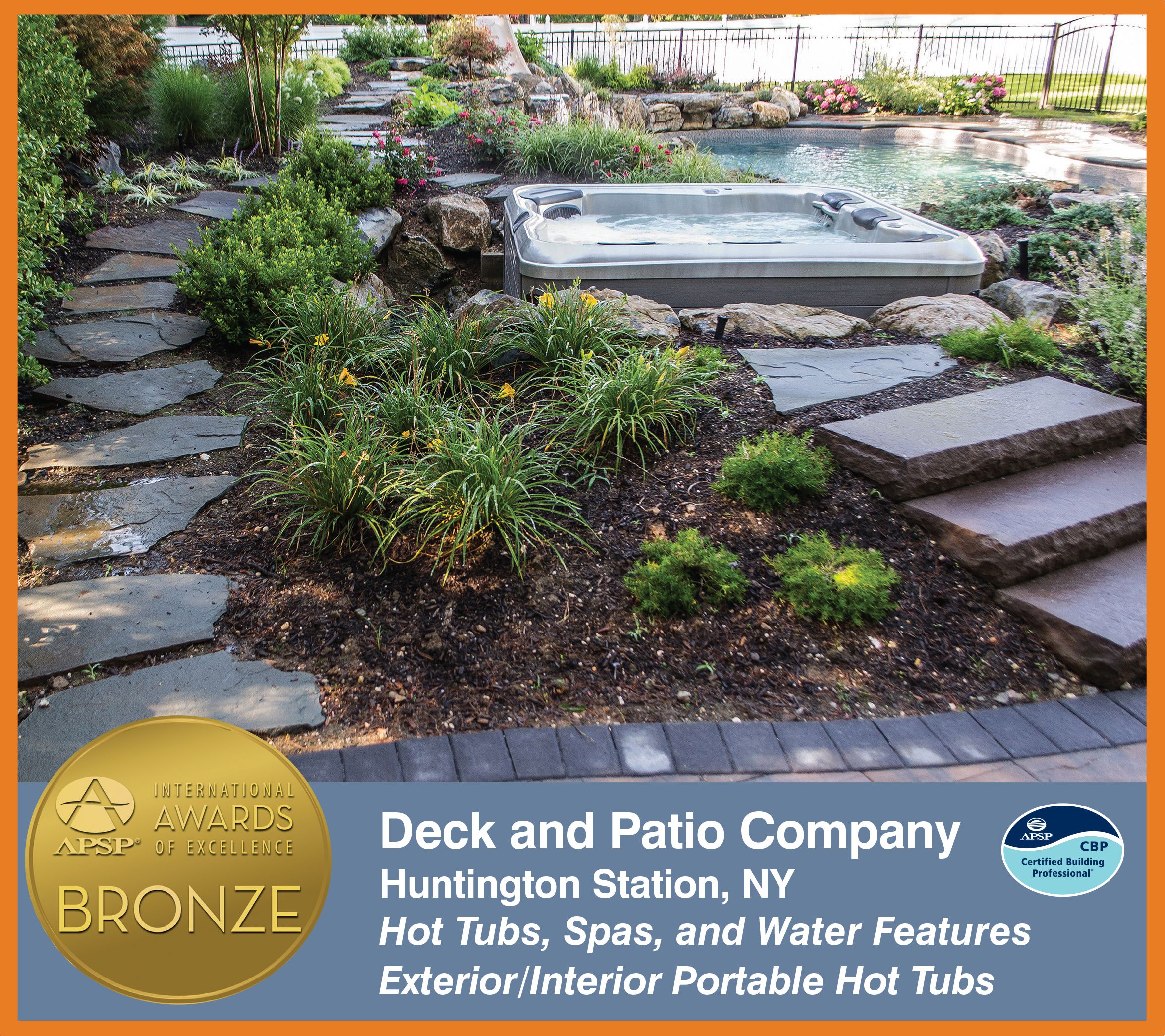
These clients wanted a spillover spa, but so they could enjoy it all year, they wanted it separate from the pool. To provide the look they wanted, along with year-round use, we built a Bullfrog Spas portable hot tub all the way into the ground with boulders and plantings around it.


Deck and Patio’s APSP Bronze Award (Fort Salonga, NY):

Deck and Patio’s APSP Bronze Award (Fort Salonga, NY):

We also added a moss rock waterfall just beneath the hot tub that spills into the pool. While it’s actually coming from the pool’s edge, this waterfall appears to be coming from a custom in-ground concrete spillover spa.


Go to Top