JuneSullivan

About June Sullivan

An expat-New Yorker, June currently lives in New Hampshire. She has been writing about architecture, landscaping, interior design and the hot tub lifestyle for over 20 years. Her publishing credits include Newsday, The Boston Globe, and Long Island's HOUSE magazine. UPDATE: Quarterfinalist: ScreenCraft Cinematic Book Competition 2024

Backyard Natural Retreat Is Splendid in all Seasons

Design/Build: Even when snow is falling, a backyard oasis can offer delightful daily escapes


Deck and Patio’s outdoor living expert finds that backyard natural retreats — once championed for their “staycation” potential — are becoming more and more popular for short daily escapes. Indeed, quiet moments listening to the trickle of water as birds sing offer ongoing opportunities to disconnect from technology, so sorely needed in today’s modern life. However, many do not realize that these daily escapes can be equally enjoyable in winter!

While The Koi Hibernate

If you add a backyard koi pond as part of your retreat, it no doubt will include a small cave where the koi can lay dormant during winter months. However, that does not mean you need to hide in your indoor home-cave. By including an in-ground or above-ground spa in your backyard oasis, a bubbling, steaming spa will be waiting every day to warm your cold bones, rejuvenate, and supply the ideal spot to watch and listen to winter birds at their feeders — a true winter wonderland!


“Winter Wonderland” Backyard Oasis:

“Winter Wonderland” Backyard Oasis:

By including an in-ground or above-ground spa in your backyard oasis, a bubbling, steaming hot tub will be waiting every day to warm your cold bones, rejuvenate, and supply an ideal spot to hear the winter birds sing from their feeders.


Splendid In Winter

Imagine a beautiful outdoor retreat with rushing waterfalls that frequently glistens with ice crystals as the cold months settle in. Also, picture the extraordinary sunsets and starry nights that shine through winter’s crisp, clear air — made all the more splendid by a vanishing edge, or “infinity” pool or pond, bringing vistas right up to your backdoor.

Backyard Retreat That Is Splendid In Winter:

Backyard Retreat That Is Splendid In Winter:

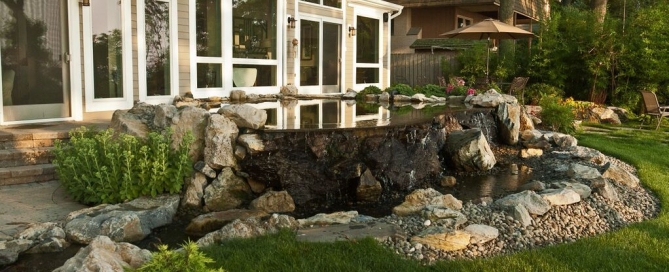
The clear, crisp winter air makes for extraordinary sunsets and starry nights — made all the more splendid with a vanishing edge pool or pond.

Under the stillness of one of our large multi-faceted water features (vanishing edge upper pond and lower pond, waterfalls, and a gentle stream) Deck and Patio’s outdoor living expert installed an extremely high tech and a complex natural biological filtration system that continuously maintains the feature’s crystal clear water.


Backyard Water Features/Natural Biological Filtration:

Backyard Water Features/Natural Biological Filtration:

An extremely high tech and complex natural biological filtration system maintains this feature’s crystal clear water.


Biological Filtration System

This water feature project includes three bodies of water: two ponds at two levels, and a 3,000-gallon underground storage vault of water – all kept clear and clean with “biological filtration” through the use of beneficial bacteria, plants and other filter media.

The vanishing edge upper pond is raised in front of a bluff. Water spills from it into a delightful connecting meandering stream down to the lower pond located at the side of the house.

Water is pumped from the underground vault to both ponds through variable energy efficient speed pumps. In the upper pond, water enters from its floor. In the lower, it enters through a separate bog – a natural filtering system – and continues through a waterfall into that pond.

Except for what is pumped in from below, everything works through gravity along gradations that our team created in the landscape. Every part of the water feature has a reason and purpose and works together in an ecologically friendly way.

When It’s Easy Being Green

In autumn, leaves from the trees fall into the water and are pushed along the stream where they are caught in a bed of gravel and are easy to remove, like emptying a skimmer basket in a pool. Considering the energy efficient pumps, which only ramp up when the homeowners arrive home, as well as the fact that the system harvests rain water to help sustain its underground water reserve, it’s a project to delight the heart of any green enthusiast.

Multi-Functional Water Feature:

Multi-Functional Water Feature:

Every part of this water feature (summer view) has a reason and purpose and works together in an ecologically friendly way.


By |2017-01-21T16:34:40-05:00December 12th, 2014|Uncategorized|0 Comments

Rainwater Harvesting: When It Rains, It Stores

Thanks to a revolutionary design from Aquascape Inc., today you can combine a recirculating decorative water feature (humble or grand) with a sub-surface rainwater harvesting collection system. This collected water can be used at your residence and/or business for jobs that don’t require treated water: washing vehicles, watering a lawn, spraying down a deck, or nourishing a garden.

The Deck and Patio Company — through its Rainwater Harvesting Group — specializes in  these Aquascape’s RainXchange systems. Recently, we’ve been at work in Brooklyn, New York, where a very tight city backyard is barely 25’x 12’.

“The clients have a four-story walk-up,” says our Outdoor Living Expert, Bill Renter. “They wanted to collect all the water that comes off their roof.”

In addition to the obvious “green” aspects, the clients were keen to take advantage of certification from the U.S. Green Building Council’s LEED (Leadership in Energy & Environmental Design) program. According to the Council, certification may allow property owners to “qualify for a host of incentives like tax rebates and zoning allowances. Not to mention they retain higher property values.”

Renter adds that rainwater harvesting also reduces energy and water bills, sometimes by as much as 40%. LEED points can accrue from reducing municipal water requirements, by using locally-sourced materials that reduce transportation costs, and from reusing old bricks or materials, etc.

The following photos and video show The Deck and Patio Company hard at work at this Brooklyn project; we’ve also included two photos that showcase how beautiful a completed water harvesting job can look.


Updating Small Backyards:

Updating Small Backyards:

In addition to the the RainXchange system, these clients wanted a small built-in barbecue; they have a vegetable garden and we planted drought-tolerant xeriscape plants across from it.


Installing Rainwater Harvesting Reservoir

Installing Rainwater Harvesting Reservoir

Water will come off their Brooklyn 4-story roof and collect in a 500-gallon underground rainwater harvesting reservoir. When it’s full, water flows into an overflow regeneration zone where it can perk slowly back into the ground.


Private Water Systems:

Private Water Systems:

Previously, any excess water from rainfalls etc. ran off into the New York City sewer system; now, because rain water and any overflow will be collected, stored, and controlled, the water for plants and vegetables is completely disconnected from the city sewer system.


Small Yard Renovations:

Small Yard Renovations:

We had to dig a hole 4’ x 6’ and 3’ deep to install the underground 500-gallon reservoir. This required digging out soil and filling 5-gallon buckets that our team carried one at a time down to the basement, up stairs, and out to a dump truck in front of the house.


Rainwater Harvesting Components

Rainwater Harvesting Components:

We used all Aquascape Inc. products, e.g: an underlayment to absorb roughness and prevent rocks and roots from puncturing equipment; AquaBlox (plastic matrix modular system for water storage and filtration), submersible pump to operate the water feature (bubbling rock) rock, etc.


Aerating Water Feature

Aerating Water Feature:

We drilled a hole through a rock to create a bubbling rock feature; water bubbles up and then goes back down; having a connecting water feature allows the water to be continually aerated, thereby helping to purify the water.


Pondless Waterfall:

Pondless Waterfall:

The “pondless” waterfall we installed some time ago for these clients collects the waterfall’s falling water in an underground tank with a pump that circulates and helps keep the water for this feature pure.


Multi-faceted Water Feature

Multi-faceted Water Feature:

This more ambitious water feature by Deck and Patio includes a stream, and multiple waterfalls — all recirculated through the same RainXchange water collection system. City water is not used.


Award-Winning Project Showcase: Turning Challenges Into Benefits

When creating this beautiful backyard retreat, the first challenge facing Deck and Patio Company’s Outdoor Living Expert, Bill Renter, was meeting the expectations of both the husband and wife: he wanted a place to take full advantage of the sun; she wanted a cool place to relax with friends.

The solution was (1) to position the pool in the sun, in order to gain the most sun exposure during the day and, (2) for congregating in comfort, create a shady pergola, over a granite swim-up/walk-up bar and patio.

The second challenge was ensuring the plan would fit in the 12-foot elevation change from the rear of the home to the back of the property. To alleviate this problem, we built a multi-tiered Techo-Bloc system of patios, including a raised patio, with a wide, wrap-around stair, leading to the pool, lower patio, and a sunken swim-up-bar patio.

We did all this without using rails and fences, which would obstruct views of the natural stone waterfall and vibrant landscaping. By designing wide stairs, multi-level stone walls and generous planting beds, we were able to create a colorful buffer between the upper and lower levels.

Both husband and wife were delighted with the design, and the property’s most difficult challenge — its rising elevation — was turned into a benefit.

This project won several awards, including the prestigious Gold prize from the National Spa and Pool Institute (NSPI).


Patio Landscaping:

Patio Landscaping:

Matching steps, walls, coping and moss rock add elegant finishing touches to the Techo-Bloc patios that surround this inviting free-form vinyl pool.


Pool-Side Bar

Pool-Side Bar:

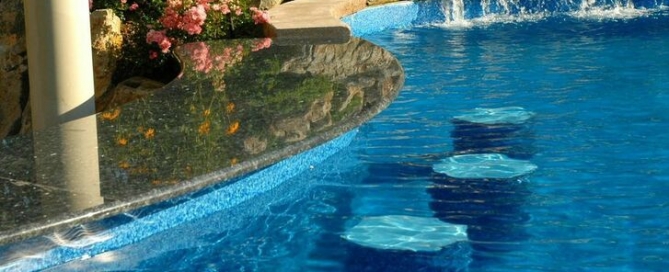
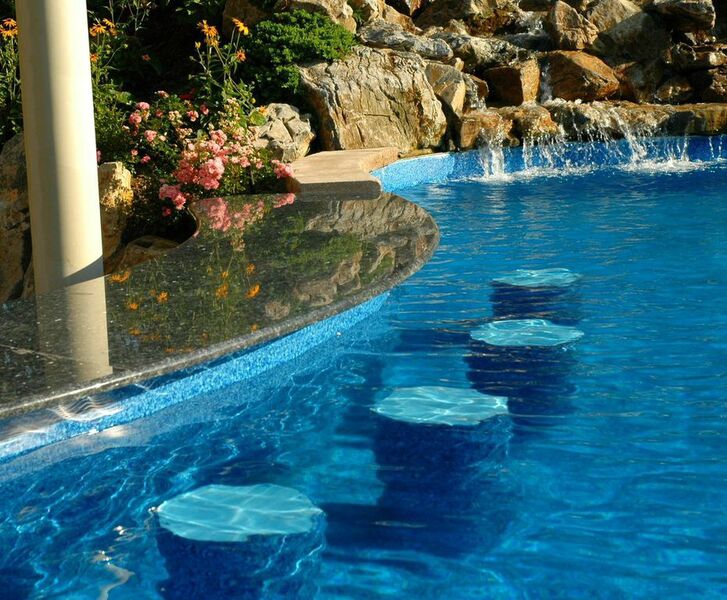
This 32-foot, U-shaped swim-up granite-topped bar, in cultured stone and rock facing, curves around to be enjoyed from patio as well.


Techo-Bloc Patios

Techo-Bloc Patios:

Techo-Bloc’s Elena/Sandlewood, with its warm gray and tan earth tones, in random sizes, creates welcoming spacious patios around new free-form vinyl pool.


Vinyl Pool Swim-Up Bar

Vinyl Pool Swim-Up Bar:

For the ultimate in outdoor socializing, guests can walk up to, or swim up to, this U-shaped bar and sit on patio or in-pool stools.

Outdoor Enthusiasts Get New Deck and Hot Tub

“We were originally contracted to do only a deck for these Centerport, Long Island clients,” says Deck and Patio’s Outdoor Living Expert, Bill Renter. But, as is often the case when building one, the homeowners soon after requested a spa.”

It was very important to them that any new deck and railing would embrace, and not block, their lovely backyard water views. Regarding the hot tub, they wanted it to blend well with the deck, and that the complete outdoor area be maintenance-free as well as elegant.

“A key decision was the stainless steel cable railing we chose, which does not obstruct the yard’s water views from any place on the deck, even when they are sitting,” says Renter. “And, indeed, all the materials used for the deck do not require painting or staining.”

Our team also helped them choose a maintenance-free encasement for their new Bullfrog Spa; it coordinates handsomely with the Trex Transcend deck planks.

“Plus we set the hot tub on a matching custom platform to make it easily accessible from anywhere on the two-story deck. It’s just steps out their back door, which ensures these outdoor enthusiasts will enjoy it even during snowy and cold winters — something they especially wanted.”

This  project won The Deck and Patio Company a prestigious 2014 Merit award from the Northeast Spa & Pool Association (NESPA).


Decks and Railings

Decks and Railings:

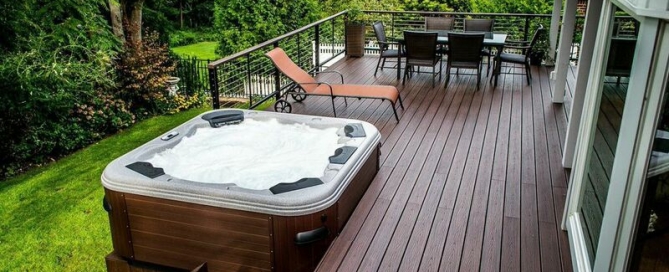
Trex “Lava Rock” Transend decking and CableRail by Feeney together offer not only the sleek look the homeowners wanted, but the cable infills do not obstruct views from any position.


Deck Railings

Deck Railings:

The rail caps are Trex Deck board chosen to match the decking; the railing infills are CableRail by Feeney and the balusters part of Feeney’s Designer Rail system.


Deck Lounge Area

Deck Lounge Area:

Whether it’s from the hot tub, or the dining and lounge areas, the deck is an ideal spot to appreciate the property and location.


Portable Spa

Portable Spa:

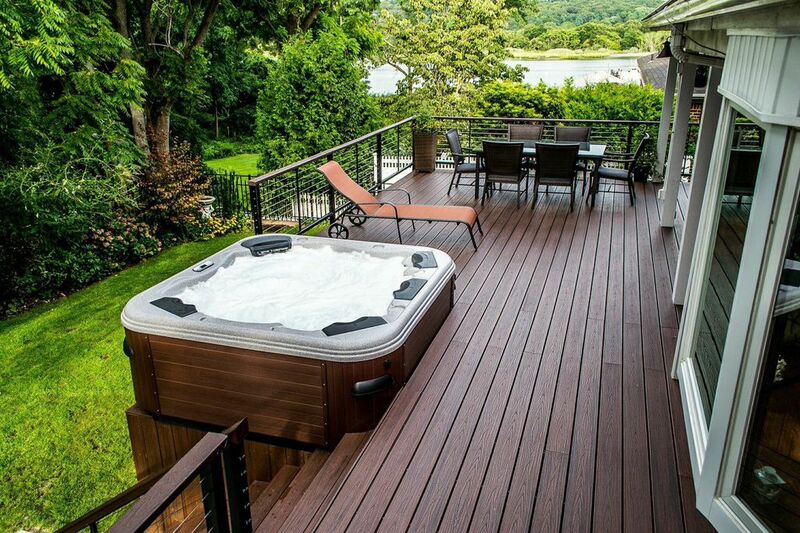
Deck and Patio helped the homeowners choose the right-sized portable spa and integrated it into the new deck, partly by adding a spa encasement of mahogany PVC boards that look like wood, but, like the deck material, will not rot, and which suggest a modern, rich and upscale look.


Deck Dining Area

Deck Dining Area:

It was important that when the clients sat on their new deck, the railing infill (here made of stainless steel) did not spoil their exquisite views.


Spa Installation

Spa Installation:

Set high on a platform, the spa is conveniently located just steps out their back door, ensuring they will use the spa even during snowy and cold winters — something these homeowners especially wanted.

Project Showcase: What Would Your Ideal Outdoor Room Include?

“Sometimes we dream of an outdoor space we’d love to have ourselves, — like this four-seasons outdoor room — and without fail, our team comes across a client who wants it, too,” says Deck and Patio’s Outdoor Living Expert, Bill Renter.

That said, the idea for this climate-controlled four-seasons room didn’t come about all it once. It evolved in degrees. Deck and Patio had been contracted to build an entire backyard retreat, in three phases, for these clients. In phase one, we built a sound-barrier fence to block noise from a nearby busy street. Phase two, which eventually included this four seasons room, was for a Trex Transcend deck and railing, an outdoor kitchen, and an opened roof structure for sitting out and enjoying the yard.

“When we were creating the deck and open roof structure, however, after an evening of being pestered by insects, the clients decided they wanted it screened. Soon screens turned into windows for added protection during windy times. And, of course, once it was to be fully closed in, opportunities for special amenities opened up.”

First, to ensure the completed outdoor room would be in keeping with their two-story brick home, Renter consulted with an architect. The completed four seasons room not only harmonizes with their home, it boasts fully operating windows, as well as screens, automated Mitsubishi ductless heating and air conditioning, flat screen television, and enough room for their young child to use his ride-on toys.

In the end, the clients new outdoor room more than matched Deck and Patio’s own dream for such a space. (Note: Phase three, and the final phase of their outdoor retreat, will be a new pool and surround, and a pond.)


Four Seasons Room

Four Seasons Room:

The outdoor room’s large Anderson windows offer a 360-degree view. These scenes will be even more enchanting when the pond, swimming pool and surround are completed in phase three. Then the clients will be able to watch children in the pool, and relax in their outdoor room at the same time.


Landscaping

Landscaping:

Hydrangeas and long-blooming roses add color and brightness to the landscaping around the new four seasons outdoor room. The room’s white siding of PVC trim board is maintenance free, is paintable, and will never rot. With PVC lattice in deep brown underneath, it all coordinates perfectly with the deck and railing.


Trex Transcend Decking

Trex Transcend Decking:

The Trex Transcend decking has a picture-frame border where two boards of a different color frame the entire deck. The framing is “vintage lantern” and the body is “tree house.” The flooring inside the outdoor room is also Trex Transcend.


Trex Transcend Railing

Trex Transcend Railing:

The Trex deck railings have white posts and rails and “vintage lantern” balusters. Trex LED lighting is added on the post caps to shine down on the posts; the stair risers have Trex accent riser lights which shine on the stair treads.


Outdoor Kitchen

Outdoor Kitchen:

The new outdoor kitchen, with granite top, has a cultured stone facade that goes all the way to the ground; barbecue, refrigerator, double-side burner, and three drawers are made with high quality stainless steel.


Keeping Pond Fish Safe and Healthy in Winter

Updated 11-30-23

Fall Backyard Maintenance: Along with covering your swimming pool at the end of summer, it is helpful in due course to put up pond netting to collect foliage debris; nets also offer an extra layer of safety for your pond fish by protecting them from birds and other animals.

Fall Backyard Maintenance:

If you’ve seen to fall maintenance for your pond already, you’re on your way to ensuring a safe and healthy pond in winter. By fall maintenance, we’re referring to cleaning the skimmer basket, trimming any dead or dying foliage, preparing your waterlilies for winter, etc. 

And you also need to add cold water bacteria to help keep the water clean and clear.


Getting Ready for Winter

It is a common myth that you can’t leave your pond fish outside once the cold sets in. Actually, fish do just fine during winter. That said, Deck and Patio’s own Dave Stockwell does caution to be alert. When ice covers the pond, the fish might not be getting enough oxygen.

This can be remedied as long as you give them:

  • two feet of water to swim in,
  • oxygenate the water,
  • and keep a hole in the ice with a heater, bubbler and an aerator. This allows the naturally produced gasses to escape from under the ice.

If the above efforts fail to keep it from freezing, Aquascapes Inc. designs manager suggests using a pond de-icer. “This will keep a little hole in the ice so gases can escape,” he says. “While some recommend boiling water to create an opening in frozen-over ponds, that should be discouraged. It will only ice up again quickly.“

Gronwick also says to avoid chopping or sawing the ice to open a hole. The noise and vibrations will stress out the hibernating fish to a point they could die.

That done, Mother Nature will do the rest. The fish will spend the entire winter hibernating at the bottom of the pond, or in a cave designed for this, and then will slowly wake up as the water warms in the spring.  The fish do not need to eat during this time and, in fact, shouldn’t be fed at all.  


Prepare Ponds in Fall for Winter:

Prepare Ponds in Fall for Winter:

As mentioned above, before winter sets in, fall maintenance is important. For example, carefully look over your plant material and remove dying plant material. These materials rot and build up poisonous gases that can’t escape through ice when it forms. Such conditions might mean the koi are no longer simply hibernating, but are in a dangerous state of torpor.


Pond Waterfalls in Winter: (Photo/Aquascapes Inc.)

Pond Waterfalls in Winter: (Photo/Aquascapes Inc.)

Keeping any waterfalls running during cold months helps move the water so ice doesn’t form. But if ice builds up, pond aerators can put bubbles back in the water to add oxygen for the fish.


Contented Pond Fish in Winter: (Photo/Aquascapes Inc)

Contented Pond Fish in Winter: (Photo/Aquascapes Inc)

This pond has been cleared of excessive plant material and ice does not cover over the pond so that the fish are happily hibernating.


Aquatic Plants in Winter:

Aquatic Plants in Winter:

Hardy water lilies (shown here) that float on the water’s surface and have a short blooming period can withstand the cold winter months nicely. Lotuses also can withstand the cold winter months because they bloom in summer and go dormant in winter. Note that frost kills water hyacinths; water lettuce, which fights algae, should be wintered in a warm spot that is well lighted as they will not survive in the pond over winter.


Prepare Pond Fish for Winter:

Prepare Pond Fish for Winter:

To be on the safe side, take water temperature regularly once it hits 55 or lower. If your pond jewels are hungry and moving about and you haven’t fed them, they will find something in the pond to eat and soon will be dormant anyway.


Pond Caves for Fish:

Pond Caves for Fish:

Ask your pond designer/builder to create a small cave, or caves, where the fish can hide and also lay dormant during the winter months. Caves are easily made from the way rocks are positioned in and around the pond.


If you have any questions, or require assistance in preparing your pond for winter, give us a call:

631-549-8100


Outdoor Fall Maintenance: A Few DIY Tips


Fall Foliage in NY's Catskills

Fall Foliage in NY’s Catskills:

Fall foliage is beautiful, but then the leaves start to fall. If you do all your own lawn maintenance, taking care of the leaves is one of a variety of chores worth your time right now, says Deck and Patio’s Outdoor Living Expert, Bill Renter.


Watch Out for Leaf Stain

Watch Out for Leaf Stain:

Leaf tannin stains pavers, concrete, and decks. It is better to remove the leaves than to, say, seal your decks and patios. Sealers need to be constantly redone, which turns into a lot of maintenance. Note: New pavers, and, specifically, Trex Transcend decking materials, do not require sealants, and it is actually better not to put it on such products.


Keep Off The Grass

Keep Off The Grass

It’s equally important to keep leaves off the grass. You don’t want your healthy grass to get matted down, because, in winter, it needs sunlight and oxygen.


Fall Tree Maintenance (Photo/Aquascapes Inc.)

Fall Tree Maintenance: (Photo/Aquascapes Inc.)


This is a good time of year to cut any dead tree limbs away, so that coming snow or ice storms won’t cause them to crack and fall. Falling limbs can result in accidents to people, cars, and homes.


Tip: Before all the leaves have fallen, says Renter, look up your trees to see if any branches are completely bare of leaves. This is a good indicator of what needs to be cut off. Also, look to see if any low-hanging branches are near power lines; trim these so the weight of any ice or snow won’t pull them down into the wiring.


Fall Driveway Prep

Fall Driveway Prep

To prep your driveway and walkway for winter, it’s helpful to get supplied with fiberglass stakes (sometimes called “plow stakes” or “snow stakes”) for placing along your driveway in advance of the first snow storm.

You position the stakes to indicate where any costly Belgium Block or other edging could be damaged from snow plows. One end of the stake is pointed for easy insertion in the ground. Also, they come in different colors and you can let a particular color indicate, for example, where a fire hydrant is, the regular curb, your driveway entrance, etc.


Falling Leaves, Feeding Koi, and Other Pond Tips

Plants and Falling Leaves

“If you want to greatly diminish spring pond maintenance,” says Bill Renter, Deck and Patio’s Outdoor Living Expert, “now is the time to take a few steps to prevent too much debris from accumulating before winter sets in.”


Falling Leaves Affect Pond Ecosystems:

Falling Leaves Affect Pond Ecosystems:

To get some tips on how to protect our ponds, pond expert Dave Kelly at Aquascapes Inc. (St. Charles, IL) offers this advice:

“The best idea is to put up pond netting before the leaves fall,” he says. “But if you didn’t do that in time, you can use a long-handle pond net to scoop down to the bottom and pull out leaves and other debris.”

Ideally, put your net in place before leaves begin falling. Then, simply pull it out when they’ve all dropped. You can tent the net so it doesn’t sag into the pond when it gets weighted with leaves, say experts at Aquascape Inc.


Value of Pond Netting: Photo: Aquascape, Inc.

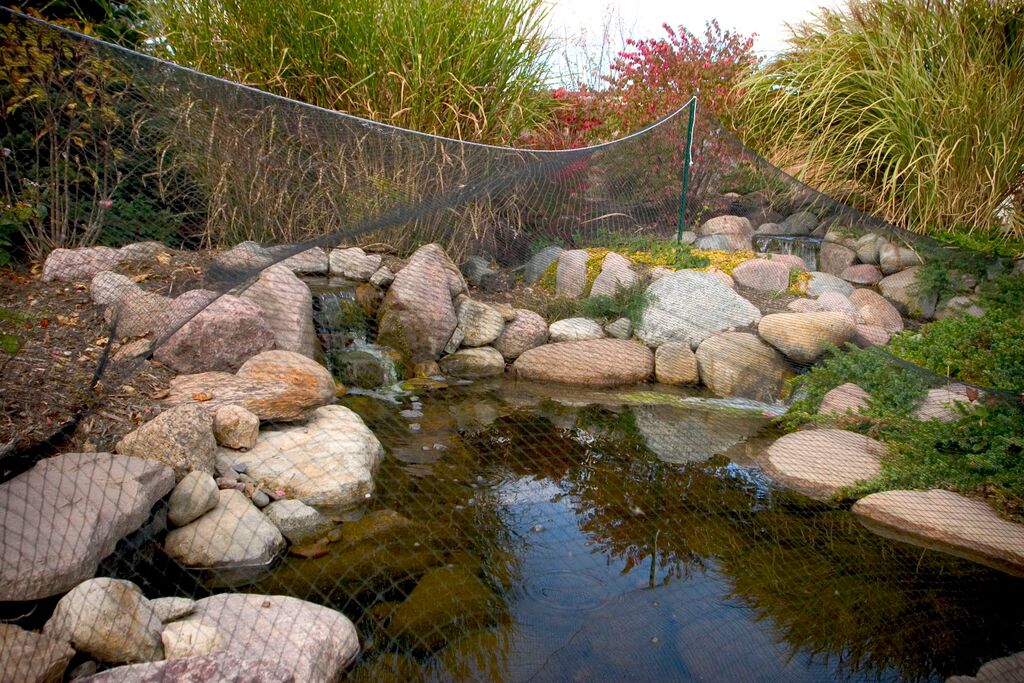
Value of Pond Netting: (Photo: Aquascape, Inc.)

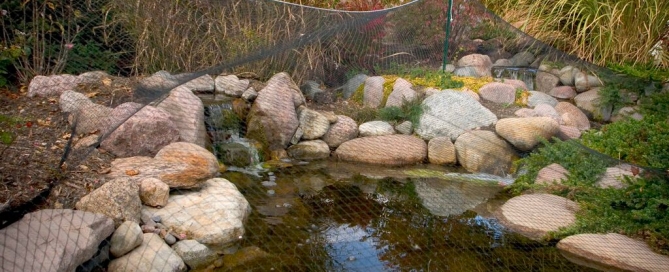
Pond netting is only needed for a short time and will save you countless hours come spring. Ideally, put your net in place before leaves begin falling. Then, simply pull it out when they’ve all dropped. You can tent the net so it doesn’t sag into the pond when it gets weighted with leaves, say experts at Aquascape Inc.

Kelly also suggests trimming back and removing dead foliage from aquatic plants to help remove excessive organic material that would otherwise decompose in the water feature.


Caring for Pond Lilies in Fall:

Caring for Pond Lilies in Fall:

Pond lilies are idyllic water plants. However, during early Fall, it’s a good idea to cut them back to just about the base of the plant; also trim back any marginal plants that might eventually droop over into the water.


Unwanted Pond Debris: (Photo: Aquascape, Inc.)

Unwanted Pond Debris: (Photo: Aquascape, Inc.)

Since some debris will make it into your pond no matter how hard you work, Aquascape recommends adding a cold water bacteria treatment, which has concentrated strains of beneficial bacteria that works well below 50 degrees (F).  Dave Kelly recommends adding it routinely to help maintain water clarity and quality.

Caring for Pond Fish in Fall

You can — and should — plump up your darlings to survive winter hibernation, by gradually increasing how much you feed the as temperatures start to drop. When pond water gets below 59 degrees, use fish food made for cold water. As the temperature continues to drop, gradually reduce the amount you feed them.

Once temperatures go below 55 degrees, says Dave Kelly, the metabolisms of pond fish slow way down. And when pond water gets down to 50 degrees, do not feed the fish any more. Their systems shut down in the colder water, and food sits inside them and rots. They get very sick and diseased from this.


Pond Fish in Fall

Pond Fish in Fall:

There is nothing cuter than your koi coming to you for more food. However, once the water gets to 50 degrees, experts say stop feeding them entirely.


Healthy Ponds Come Spring:

Healthy Ponds Come Spring:

Once Spring arrives, and your pond and fish are healthy and thriving, you’ll be glad you took such good care of your pond in the Fall.

How Are You Using Fall’s Harvest For Outdoor Displays?

When it comes to Fall’s bounty, Mother Nature’s harvest — rich with gorgeous plants, fruits, vegetables and even berries — is perfect for decorating yards and front door entries.

For ideas in what makes the best outdoor displays, we spoke with horticulture buyer Alison Caldwell at Hicks Nurseries (Westbury, Long Island).

“Come Fall, it’s all about hardy mums, winter pansies, and ornamental grasses such as Maiden Grass or Fountain Grass,” she says. “Also, switch grasses start to set their seed heads about now and get a great Fall color.”

Caldwell adds that grouping interesting plants together in combo planters present a bigger punch of color and interest: beauties like Montauk daisies, with their white petals and yellow centers, hardy mums (also ideal for mass plantings on their own), and ornamental peppers. Of course, cabbages and kale are great options, which she says can last all through winter, if the weather isn’t too bad.

“Changing out your petunias or other summer annuals with Fall colors offers a great welcome at your front door,” says Caldwell. “Mums are ideal for this. It’s also common for people to decorate their mail posts with corn stalks or add hay bales around.”

Other tips: wheat sheaves can look great on an entry door, pumpkins in different colors can be mounded together in a planter on the veranda, or, if you’re crafty, you can make a wreath of small gourds and autumn berries for your door.

Post (here or on Facebook) your own ideas for using Fall’s harvest to decorate outdoors.


Outdoor Decorating for Fall:

Outdoor Decorating for Fall:

Believe it or not, the pumpkin is not a vegetable — it’s a fruit, and a berry at that! Along with hardy mums in bright yellow, at Deck and Patio’s design center in Huntington Station, we’ve added lots of these Fall “berries” for pops of bright orange.


Fall Decorating-Mums the Word: (Photo: Hicks Nurseries)

Fall Decorating-Mums the Word: (Photo: Hicks Nurseries)

At Hicks Nurseries, mums are on great display. Because of their hearty color, they catch the eye at a distance as well as close up. Consider grouping them in only one or two colors for the most impact.


Grouping Fall Plants: For this nice grouping, cabbage, deep red mums, and winter pansies make a bright, bold statement. (Photo: Hicks Nurseries)

Grouping Fall Plants: For this nice grouping, cabbage, deep red mums, and winter pansies make a bright, bold statement. (Photo: Hicks Nurseries)


Decorating for Fall:

Decorating for Fall:

Outside our design center, we have waterfalls flowing from a stream. Deck and Patio added white, yellow and orange mums along its banks. The full bush of green leaves shown at the top of the yellow mums is a marginal aquatic plant — the clump-forming Iris Versicolor.


Ornamental Peppers (Photo: Hicks Nurseries)

Ornamental Peppers (Photo: Hicks Nurseries)

Aren’t these ornamental peppers beauties! Grown for their decorative value, although edible, they are rather lacking in flavor, as are the leaves and flowers of the deep red Celosia Cristata (aka cockscomb) behind them.


Cabbage and Kale (Photo: Hicks Nurseries)

Cabbage and Kale (Photo: Hicks Nurseries)

Believed to be one of the world’s healthiest foods, kale and its looser central leaves is really cabbage that doesn’t form a head. Ornamental kale is ideal for your Fall garden; with its sister cabbage, they reach their best color when it gets cold. Note: ornamental kale isn’t quite as tasty as the supermarket kind, so best leave it in the garden.


Have a great day!

Have a great day!

Wishing everyone happy gardening from The Deck and Patio Company, Huntington Station, NY!


For Fiery Fall Foliage: Are You Barking Up the Right Trees?

To get the lowdown on the best trees to plant for fiery Fall color, Deck and Patio spoke with Angelo Puleo, Nursery Division, Bissett Nursery (Holtsville, NY).

“One of the most popular and widespread deciduous trees that produces bright reds in autumn is the beautiful Maple tree,” says Puleo. “In particular, we recommend Sugar Maples, and, of course, Oaks for great Fall red color.”

Puleo also recommends the Cleveland Select Pear for robust color. Like the Oak and Maple, it is also hardy and can withstand most winds and storms, including ice storms —a real plus in our neck of the woods.

“In Spring, the Cleveland Select bursts awake in beautiful white flowers, and in the Fall, its leaves offer up a deep orange-y-red blaze of color,” he says. Another option is the Crape Myrtle tree, which, as Puleo admits, is not quite as brilliant as the other trees, but it does offer an attractive reddish-orange color. When the Crape Myrtle finishes flowering in the Fall, it also pods-up with berries, and attracts such delightful visitors as the Yellow-rumped Warbler, a sweet little visitor who feeds on these berries after insects are gone.

In addition, when it comes to smaller trees, Deck and Patio designers often consider Japanese Maples in landscaping plans; red-leafed versions of this beautiful tree offer degrees of red from Spring through Fall. Planting them in early Fall allows for new root growth in time for Spring.

Note: Be sure to ask experts at an established nursery or landscaping firm which variety of maple, etc. will produce red leaves in the Fall, as some varieties offer up a blazing yellow instead. Not that there’s anything wrong with that… that’s just for another blog post.


Red Maple in Fall: (Photo With Permission © by Jeff Dean)

Red Maple in Fall: (Photo With Permission © by Jeff Dean)

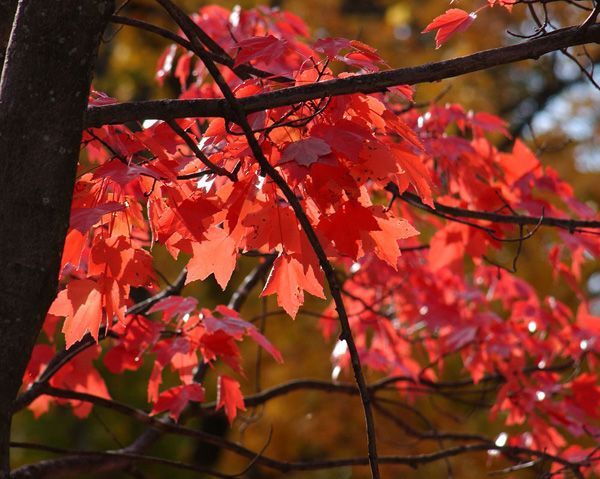
A beautiful shade tree in summer with brilliant color in autumn, the Red Maple can be planted any time of year, including Fall. Dig a hole twice the size of the root ball, place it in the ground, and fertilize and water well, says Angelo Puleo of Bisset Nurseries.


Mighty Oak: (Photo With Permission: SimMaster)

Mighty Oak: (Photo With Permission: SimMaster)

The oak grows rapidly, making it an ideal choice. Like all the trees mentioned in this blog post, leave about 10 feet between each one when planting. Note: For those who keep horses, the oak’s acorn and leaves can be toxic to animals such as as horses.


Cleveland Select Pear Tree: (Photo With Permission: Ltshears/Photos of Flowers)

Cleveland Select Pear Tree: (Photo With Permission: Ltshears/Photos of Flowers)

This tree offers up three great seasons of leaves, white blossoms in Spring (shown here), lively green leaves in Summer, and bright reds in Fall.


Bradford Pear Tree: (Photo With Permission: Abrahami)

Bradford Pear Tree: (Photo With Permission: Abrahami)

A close cousin of the Cleveland Select Pear, the Bradford is pictured here as its leaves begin to turn from green to Fall-red.


Crape Myrtle Tree: Photo With Permission: Southern Lagniappe)

Crape Myrtle Tree: Photo With Permission: Southern Lagniappe)

The Crape Myrtle tree that thrives on Long Island is a hybrid of other Crape Myrtles that flourish in warmer climates such as the Southern United States. Clusters of pink blossoms appear in late spring (shown here) which are so delicate and crinkly they look like they are made of crape paper. In Fall, it showcases bright red-orange-y leaves.


Crape Myrtle Berries: (Photo With Permission: Forest & Kim)

Crape Myrtle Berries: (Photo With Permission: Forest & Kim)

In Fall, as they finish flowering, the leaves of the Crape Myrtle pod up into pretty berries.


Yellow-rumped Warbler: (Photo With Permission: Cornell Lab of Ornithology)

Yellow-rumped Warbler: (Photo With Permission: Cornell Lab of Ornithology)

Escaping the harsher winters up north, the Yellow-rumped Warbler makes a home in our area as Fall sets in. With insects less available, it loves to feast on Crape Myrtle berries. If you plant this tree, this little fellow — and some of his friends — will no doubt visit and stay awhile.


Japanese Maple:  (Photo With Permission: Wikipedia 松岡明芳)

Japanese Maple:  (Photo With Permission: Wikipedia 松岡明芳)

This beautiful Japanese Maple is native to Japan and other nearby Asian countries such as South Korea. It’s prized for the shape of its leaves and rich red color.

Go to Top