JuneSullivan

About June Sullivan

An expat-New Yorker, June currently lives in New Hampshire. She has been writing about architecture, landscaping, interior design and the hot tub lifestyle for over 20 years. Her publishing credits include Newsday, The Boston Globe, and Long Island's HOUSE magazine. UPDATE: Quarterfinalist: ScreenCraft Cinematic Book Competition 2024

Help the Declining Bird Population While Brightening Up Your Winter Yard

Long Islanders, including many Deck and Patio clients, are strong environmentalists and nature lovers. And they are well aware of recent news reports that North America has lost 3 billion birds since 1970. 

What may be news to some is that not all the loss has been among rare birds. One in four colorful blue jays, for example, have been lost, and we recommend a SC Times post that includes some great tips on a variety of ways we all can help.

News has not been all bad though. Because of conservation efforts, populations of waterfowl have increased in recent decades. However, even with the increase in waterfowl, the overall loss in birds does tug on the conscience. 

Inviting Birds to Your Property

We may not have any snowy owls to protect, on Long island, but we can provide a safe habitat for lots of delightful birds — and birds of glorious color that can brighten our winter season.


Blue Jay

Blue Jay

Peanut Wreath

Peanut Wreath


Blue Jays, who do need help, are colorful birds that by nature are happy to stay around in winter. These avian friends love to congregate in groups come winter. They also will squirrel food away. Some have witnessed Blue Jays hiding nuts in trees.

We spoke with Sandra Vultaggio, Horticulture Consultant at the Cornell Cooperative Extension in Riverhead about attracting the Jays.

 “If you want to help Blue Jays, they really like nuts and peanuts. I use a peanut wreath and fill it with shelled peanuts. This type of feeder attracts a lot of Blue Jays.”

They are also such fun to watch — not to mention they add a lot of color against a winter  landscape.”


Cardinals

Cardinals

Cardinals

Consider how the bright red plumage of the Cardinal could cheer the dreariest of days while you’re helping to save birds overall. The male’s full-bodied red actually gets more striking during winter. This is when some of their remaining gray-tipped feathers fall off, showing even more vibrant red.

What a picture they make resting on icy branches and snow. “If you want to attract them, Cardinals love black oil sunflower and safflower seeds,” says Vultaggio.

It’s helpful to note that Cardinals usually eat early in the morning or late in the evening so make sure feeders are well stocked at these times. Also, being a larger bird, they prefer a larger feeder that won’t sway too much as they eat.


Chickadees

Chickadees

Chickadees

Chickadees prefer the same type of seeds as the Cardinal: black oil sunflower and safflower.

Vultaggio is also delighted by their sounds: “They actually say chickadee when they sing.”

Chickadees are vibrant even though, as part of the Titmouse family, they are known for their gray color and lighter bellies.

“They dine primarily on insects, seeds and berries,” adds Vultaggio.

“They are active and agile little birds. These little acrobats are a delight to watch when they hang upside down from twigs or at your feeder.


Extra Tips

1.  Vulraggio also puts out suet in winter, which she says attracts other birds including woodpeckers.

2.  Bird Baths are a great help to birds in winter 

3.  Put up bird houses designed for specific birds


Bird Baths:

Bird Baths:

A bird bath is important. Water is often scarce in the dead of winter.

Of course, you don’t want the water to ice up and there are lots of bird bath heaters, including solar heated bird baths.

Pictured immediately above is a Heated Deck-Mounted Birdbath by Allied Precision. “You’ll also find that in winter birds tend to appear in groups since many eyes make it safer to watch out for predators.” 


Upscale Birdhouses:

Upscale Birdhouses:

Granted, wild birds may not exactly be pets. But it’s trendy to treat them like they are. So it’s not surprising that fancy bird houses are growing in popularity. Indeed, there are even awards for the best design in bird houses.

The point is, a bird house can be a reflection of your own style and tastes and certainly can be upscale, all while you’re aiding in bird conservation. Besides, if our avian friends are going to sing for their supper, they might as well be housed as nicely as we are. 

It’s worth checking to learn what the birds you’re trying to attract require. For example, Blue Jays like to nest at least 10 feet off the ground so your birdhouse should be at least that high in a tree or pole. They like to use tree roots and small thin sticks to create a nest so you can place them nearby along with the food they prefer. 


Birds are, indeed, such a wonderful way to add color to your winter garden. And it feels great to know you are helping in a very small way to reverse the trends of bird loss on our continent. 

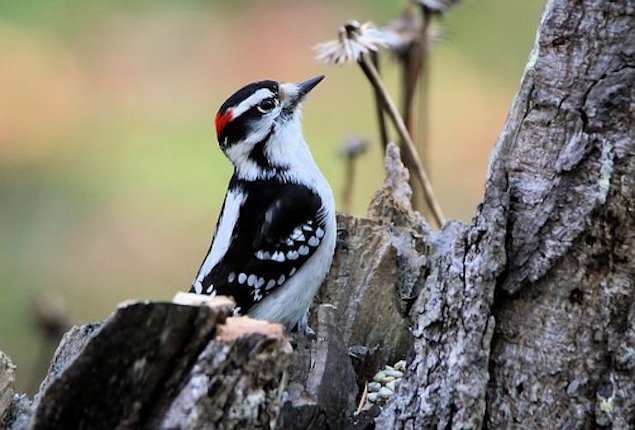
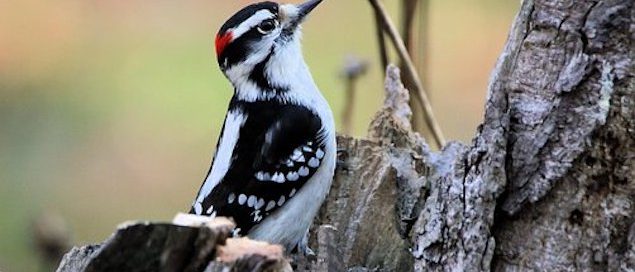
Note: Our feature photo at the top of the page is of a tit bird feeding on a tit ring. 
By |2019-11-08T16:28:33-05:00November 7th, 2019|Backyard Escapes, Environment Issues, Landscaping, Seasonal Landscapes|Comments Off on Help the Declining Bird Population While Brightening Up Your Winter Yard

Stepping Stone Walkway Ideas

Updated 9-21-23

Stepping stones in areas that get heavy foot traffic are an attractive way to protect the lawn. The stones allow grass, or “softscape,” to shine through while still providing the “hardscape” needed.

However. Is this all that stepping stones can do? “By no means,” says Dave Stockwell, owner of Deck and Patio. “While they are very serviceable, they can also contribute to the serenity of a space. They can be a key element of creating ‘contemplation’ spaces, for example.”

Today our blog is showcasing a sampling of stepping stone paths that we have created for clients — ranging from the very practical to the Zen-like in impact.

Practical Pathway

Practical Pathway


Here’s a wonderful example of the standard bluestone stepping stones being put to good use.

These clients wanted a footpath leading to their tool shed — a very practical need. But they had a small backyard. We were already installing extensive multi-level paver patios. So it wasn’t surprising they didn’t want more solid brick hardscape on the opposite side of the pool.

Instead, the bluestone stepping stones we installed allowed for greenery to show through. Along with attractive plantings on either side of the pathway, the journey to their shed offers an uplifting experience that’s not just about the tasks at hand.


Stepping Stones and Ponds

Stepping Stones and Ponds

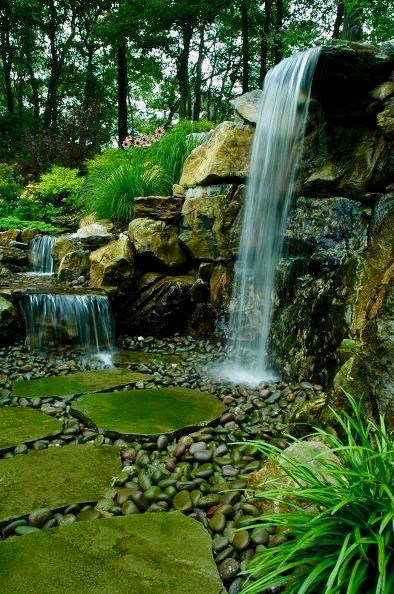
Not all stepping stones are flat bluestone slabs, however. The Japanese introduced Zen-garden landscape design centuries ago, inspiring the world to place larger stones as stepping stones across ponds and water feature

“The clients’ desire for a natural-scape in this yard helped inspire us,” says Dave.

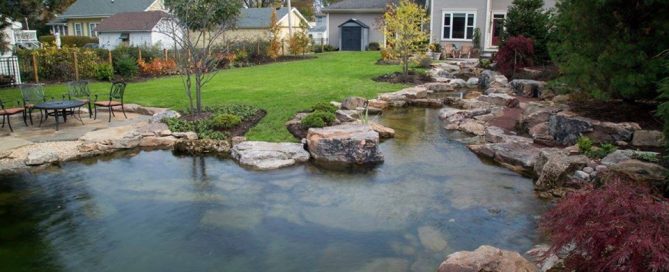
First: Deck and Patio installed regular flat bluestone stepping stones leading up to a flowing stream water feature we were doing. Then: Larger natural stones were added to walk across the stream. More flat bluestone was positioned on the other side as a walkway up to the clients’ pool area. Finally, we also added moss rock in various places which adds color and texture.

“Our clients even enjoy it in winter when the moss rock boulders around the stream become sparkling ice sculptures,” adds Dave.


Stone Island

Stone Island

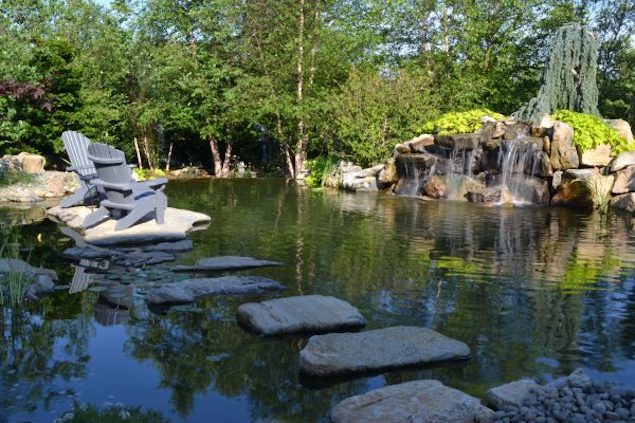
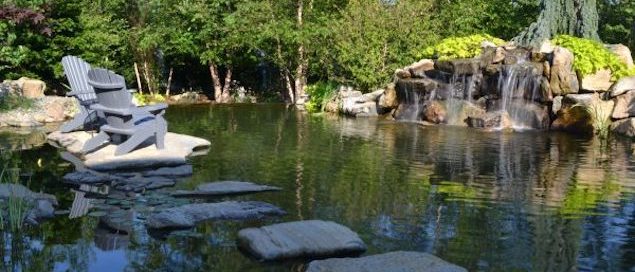
Speaking of larger natural stones, have you ever considered adding a stone “island” in a pond where you can picnic?

When Deck and patio built this lovely water feature, comprising two separate ponds next to each other, there was room in the larger pond (shown here) to add a sizable stone island.

With smooth natural stones leading to it, the homeowners have a true Zen experience walking across the still pond to their own private island.

The clients placed two Adirondack chairs on the island giving them an escape for extended moments of contemplation. Plus, the wide arms of these chairs allow room for a small lunch and cool drink while they listen to birds and watch koi swim. Surrounded by robust bright plantings, including gorgeous aquatic plants, it’s a delightful escape.


Decks and Ponds

Decks and Ponds


A deck can be part of the pond/stepping stone contemplation space, too. This Deck and Patio deck was designed with a viewing platform to enjoy the new pond with waterfalls and beautiful landscaping.

At the bottom of a set of stairs, we placed the first of several large stepping stones leading from the deck, providing a delightful walk across the pond to other viewing areas of the multi-faceted water feature.


Waterfall Walk

Waterfall Walk

So far we’ve explored stepping stones across ponds, one path leading to a utility shed, and below you’ll see stepping stones to a swimming pool.

But here the bluestone stepping stones we added lead past cascading waterfalls, including a dramatic 7’-high waterfall.

“This is a very special experience for the clients,” says Dave. “Usually waterfalls drop into a pond and you can’t walk close to them. But these do not fall into a pond, but pass through river rock into a ‘pondless’ reservoir instead.”

In the underground Aquascape Inc. reservoir, the water is filtered and then recirculated so it operates as a self-sustaining system that remains clean and clear. The different rocks used here include river rock, moss rock, spill rocks and, of course, bluestone stepping stones. They all contribute to a footpath experience one might only hope to get on a mountain trek.


Stepping Stone Path

Stepping Stone Path


We placed these bluestone stepping stones so they almost skim across the backyard sod. The path connects the clients’ pool patio to a Trex deck and second Cambridge patio located near the house.

This area is also home to a new outdoor kitchen area, complete with barbecue and refrigerator.


Backyard Nature Walk

Backyard Nature Walk


How’s this for one last example of the serenity that comes from simply adding bluestone stepping stones.

The stones make a special walking area for the homeowners as they move around their larger backyard retreat.

“While this kind of space is ideal on its own,” says Dave, “the idea came to us when we were looking for a creative way to hide their new swimming pool equipment.

“We decided to create this wilderness area with plantings etc. in a way that offered contemplation moments while at the same time finding a creative way to hide their pool equipment.”


Some Like It Hot: Enjoying Red Fall Foliage at Home

Fiery Red Foliage

Fiery Red Foliage

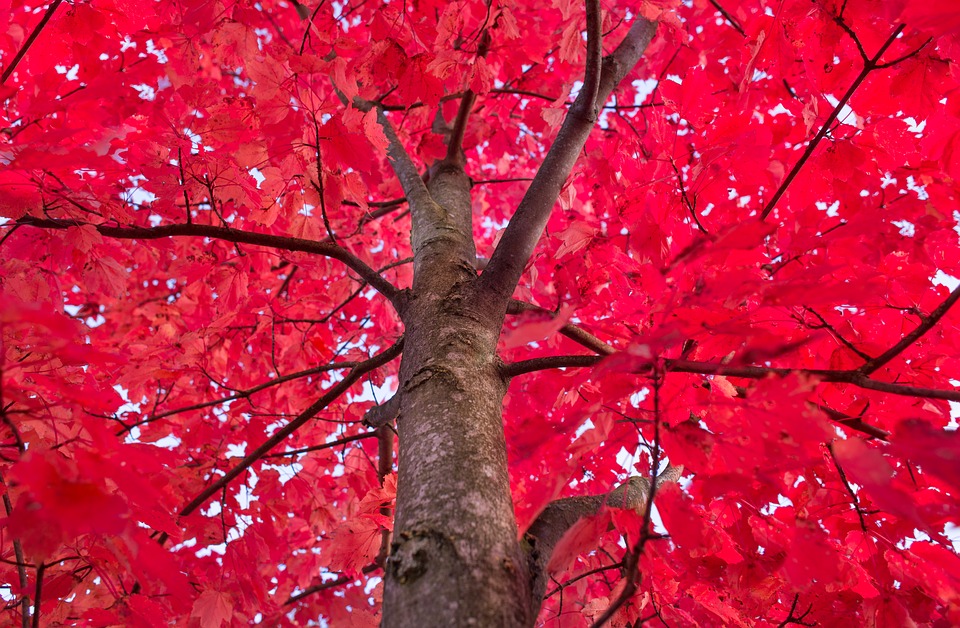
When the weather gets cool, some really like it hot…fiery red hot, that is. The heat we’re talking about is blazing red foliage — bursts of color that some find ease the pain of the outdoor season coming to an end.

More than that, say experts, the color red goes beyond sensual pleasure. It stimulates the human system — even increasing pulse and heart rates. It’s well worth it then to be able to enjoy autumn’s bursts of fiery red daily, by having the right trees in your yard.

That said, brilliant red foliage outside our very own windows requires planning. To get all the dirt on what trees to plant, we spoke with Angelo Puleo, Nursery Division at Bissett Nursery (Holtsville, NY).


Maple Trees

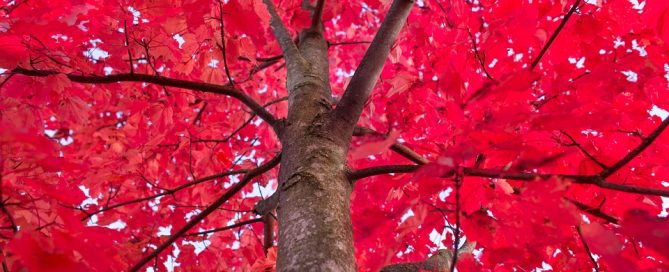
“One of the most popular and widespread deciduous trees that produces bright reds in autumn is the beautiful Maple tree,” says Pueleo. “In particular, along with oaks, we recommend Sugar Maples for great fall red color.”


Choosing the right Maple

Choosing the right Maple


Note: Be sure to ask experts at an established nursery or landscaping firm which variety of maple, etc. will produce red leaves in fall, as some varieties offer up a blazing yellow instead. Not that there’s anything wrong with that…it’s just for another blog post.


Red Maple in Fall:

Red Maple in Fall:

A beautiful shade tree in summer with brilliant color in autumn, the Red Maple can be planted any time of year, including fall.


Cleveland Select Pear 

Puleo also recommends the Cleveland Select Pear for robust color. Like the Oak and Maple, it is also hardy and can withstand most winds and storms, including ice storms — a real plus in our neck of the woods (the Northeast).

Cleveland Select Pear:

Cleveland Select Pear:

“In spring, the Cleveland Select Pear bursts awake in beautiful white flowers, and in the fall, its leaves offer up a deep orangey-red blaze of color,” adds Pueleo.

Bradford Pear Tree:

Bradford Pear Tree: (Photo With Permission: Abrahami):

A close cousin of the Cleveland Select Pear, the Bradford is pictured here as its leaves begin to turn from green to fall-red.


Japanese Maple 

When it comes to smaller trees, Deck and Patio designers often consider Japanese Maples in landscaping plans; red-leafed versions of this beautiful tree offer degrees of red from spring through fall (see last photo). Planting them in early fall allows for new root growth in time for spring.

Japanese Maple (Photo With Permission: Wikipedia 松岡明芳):

Japanese Maple (Photo With Permission: Wikipedia 松岡明芳):

This beautiful Japanese Maple is native to Japan and other nearby Asian countries such as South Korea. It’s prized for the shape of its leaves and rich red color. It’s useful to note that there are different types of Japanese maples. Some stay red ’til their leaves drop in autumn but others leaf out in brilliant reds in spring and turn to yellows and orange in fall. These, of course, can be dazzling, too, but be sure you get what you want.


Mighty Oaks

In 2004, the gorgeous and majestic oak tree was designated the USA’s official national tree. Known for its wonderful shade and lumber it grows to great heights from just an acorn. You can begin from a seed, but you might also want to transplant one that is partially grown. While you can transplant up to between 5 and 8 feet in growth, it’s best to go with a smaller tree to allow its roots to cope in the process.  

Mighty Oak:

Mighty Oak:

A few varieties of oak grow rapidly (e.g., Heritage Oak, Swamp White Oak and Northern Red Oak), making them an ideal choice. Like all the trees mentioned in this blog post, leave about 10 feet between each one when planting. The oaks are sun lovers so choose a sunny spot. Note: For those who keep horses, the oak’s acorn and leaves can be toxic to animals such as horses. 
This is by no means an exhaustive list for fiery red foliage. But we hope it’ll be enough to get your heart pumping every time you walk outdoors next fall. The fiery red scene will so take you away that you’ll forget you’re wearing a jacket.


By |2019-10-24T12:42:51-05:00October 24th, 2019|Backyard Upgrades, Creative Design, Gardening, Landscaping, Seasonal Landscapes, trees, Updating Landscape|Comments Off on Some Like It Hot: Enjoying Red Fall Foliage at Home

Backyard Pond: A Place of Reflection

Water Gardens in Giverny, France

Water Gardens in Giverny, France

The famed impressionist, Claude Monet, loved painting the water gardens in his home in Giverny, France. His paintings capture the trees, clouds, and sky reflected in the lily ponds at various times of day, in very different light — in the pre-dawn, the brightness of noonday, at sunset.

Each example allows the viewer to reflect on the differing views of beauty created by the pond’s stillness. 

We may not all be painters. But we all love to stop and reflect when we see the sky and other objects captured in still waters. 

Consider the happy owners of the following Deck and Patio vanishing edge (infinity) swimming pond. Our own Dave Stockwell explains that water features such as this project’s two man-made ponds, when correctly designed, positioned, and constructed, can provide a transforming experience in one’s life. 


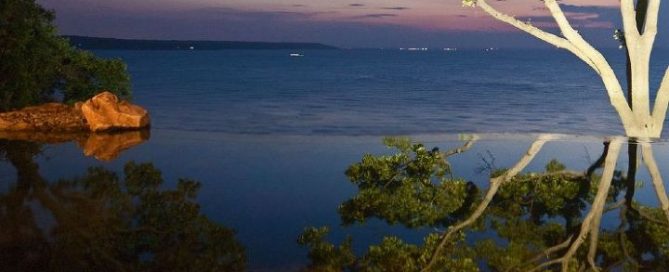
Deck and Patio Vanishing edge swimming pond capturing a pink sunset

Deck and Patio Vanishing edge swimming pond capturing a pink sunset


The same swimming pond at 4 a.m.

The same swimming pond at 4 a.m.


The vanishing edge pond in fall

The vanishing edge pond in fall


Catching the reflections of twisted trees

Catching the reflections of twisted trees


“As you can see from the next photo of this pond, sunset is a magnificent time to mediate on the illusions created by the reflecting pond’s placid water,” says Dave. “The water mirrors its surroundings so perfectly, it can be a challenge to tell the real sky, ocean, and landscape from their images on the water.”


Vanishing Edge Pond at Sunset:

Vanishing Edge Pond at Sunset


The entire project was actually two ponds. The first larger pond shown in the above photos is the vanishing edge swimming pond. The smaller of the two ponds, below, is just steps outside the homeowners’ back door. Note how beautiful the back of the house is captured in the pond and reflected back. 


Smaller of Two Backyard Ponds

Smaller of Two Backyard Ponds


Landscape design is an essential element in bringing about beautiful reflections and peaceful scenes. “Our designers used Mother Nature’s own creations — plants, moss rocks, and the water itself, to design a true mystical experience,” adds Dave. 

To learn more about these two ponds and their natural biological filtration systems, read here. 


It’s Time to Fatten Up Your Pond Fish

Our blog last week suggested netting your pond before the leaves fall. It’s worth doing in the next few days if you haven’t done it yet. This is also the time for pond owners to be fattening up their pond’s fish.  

Feeding Pond Fish in Fall

Feeding Pond Fish in Fall

When pond water gets below 59 degrees, you can — and should — plump up your darlings to survive winter hibernation. Using fish food made for cold water, gradually increase how much you feed these lovely fish as temperatures start to drop.


As the water temperature continues to drop, gradually reduce the amount you feed them. Once temperatures go below 55 degrees, says Dave Kelly, from Aquascape inc., the metabolisms of pond fish slow way down. And when pond water gets down to 50 degrees, do not feed the fish any more. Their systems shut down in the colder water, and food sits inside them and rots. They get very sick and diseased from this.

So even though there is nothing cuter than your koi coming to you for more food, once the water gets to 50 degrees, experts say stop feeding them entirely.


The Koi Will Be Fine As Temperatures Drop

Koi Will Do Fine Outdoors in Winter

Koi Will Do Fine Outdoors in Winter

It is a common myth that you can’t leave your pond fish outside once the cold sets in.

Actually, fish do just fine even during winter. That said, Dave Stockwell of Deck and Patio does caution to be alert. When ice covers the pond, the fish might not be getting enough oxygen.

This can be remedied as long as you give them:


•two feet of water to swim in,

•oxygenate the water,

•and keep a hole in the ice with a heater, bubbler and an aerator.


Note: In a few weeks, we’ll write more on caring for pond fish in winter.

Chemical Pond Treatments

Unwanted Pond Debris: (Photo: Aquascape, Inc.)

Unwanted Pond Debris: (Photo: Aquascape, Inc.)


This is also the perfect time to treat your pond ahead of the cold weather. Realize, that even if you netted your pond, some debris will make it into the water no matter how careful you are.

Dave Kelly recommends adding a cold water bacteria treatment, which has concentrated strains of beneficial bacteria that works well below 50 degrees (F).

Kelly recommends adding it routinely to help maintain water clarity and quality.


Healthy Pond Come Spring

Healthy Pond Come Spring

Do a little pond maintenance (see last week’s blog) and care for your pond fish, and when spring arrives, you’ll be glad you did. Your pond will require much less work to begin your new season of pond-side outdoor living .

If you have any questions or would like assistance with preparing your pond or caring for your fish, contact our office at 631-549-8100.

By |2019-10-10T12:08:51-05:00October 10th, 2019|Ask the Experts, Koi Ponds, Living Landscapes, outdoor maintenance, Plantings/Pondscapes, Ponds & Water Features, Seasonal Landscapes|Comments Off on It’s Time to Fatten Up Your Pond Fish

Use Pond Netting: Like Apples, Leaves Don’t Fall Far From the Tree

Apple Picking Season

Apple Picking Season


One way you know it’s fall on Long Island is apple-picking kicks into gear just as leaves start changing color. Perhaps the smell of warm cider against the backdrop of bright colored leaves is Mother Nature’s consolation for taking away summer.

Of course, like all good things, this consolation comes with a few chores. Because what follows peak color (expected to arrive here around October 19th) is the inevitable clean up.


Fallen Leaves Affect Pond Ecosystems

Fallen Leaves Affect Pond Ecosystems


If these leaves fall on the lawn, they can easily be raked and collected. However, if you have a pond or other water feature, those fallen leaves can cause a bit of a mess and a lot more work come spring.

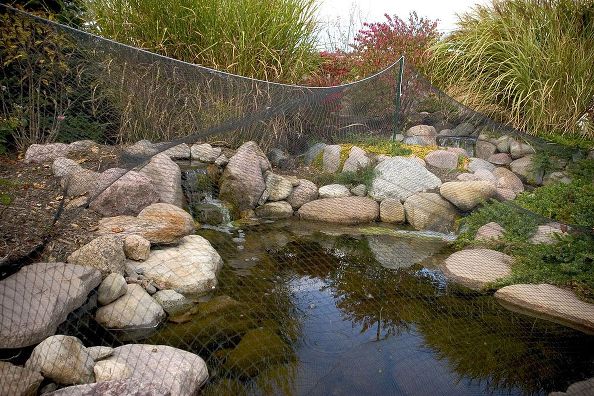
Fortunately, there is an easy solution. “It’s a good idea to get pond netting up before the leaves begin to fall,” says Dave Stockwell of Deck and Patio.


Value of Pond Netting: (Photo: Courtesy of Aquascape, Inc.)

Value of Pond Netting: (Photo: Courtesy of Aquascape, Inc.)

Ideally you’ll have your netting up before any leaves fall. And then simply pull it out when they’ve all dropped. “And you can tent the net so it doesn’t sag into the pond when it gets weighted with leaves,” adds Dave.

The netting will save countless hours come spring says Dave. “Of course, if you’re a bit late doing that, you can always use a long-handle pond net to clear out the debris, but it’s much easier if you use a net.”

Another good idea, says Dave, is to trim back and remove and dead foliage from the aquatic plants before or after you put up the net. This cuts down excessive organic material that might otherwise decompose in the water feature.”


Caring for Pond Lilies in Fall:

Caring for Pond Lilies in Fall:

Pond lilies are idyllic water plants. However, during early fall, they are one of the plants that it’s a good idea to cut back to just about the base of the plant; also trim back any marginal plants that might eventually droop over into the water. 


Unwanted Pond Debris: (Photo: Aquascape, Inc.)

Unwanted Pond Debris: (Photo: Aquascape, Inc.)


Since some debris will make it into your pond no matter how hard you work, Aquascape Inc. recommends adding a cold water bacteria treatment, which has concentrated strains of beneficial bacteria that works well below 50 degrees (F).  Their expert, Dave Kelly, recommends adding it routinely to help maintain water clarity and quality.


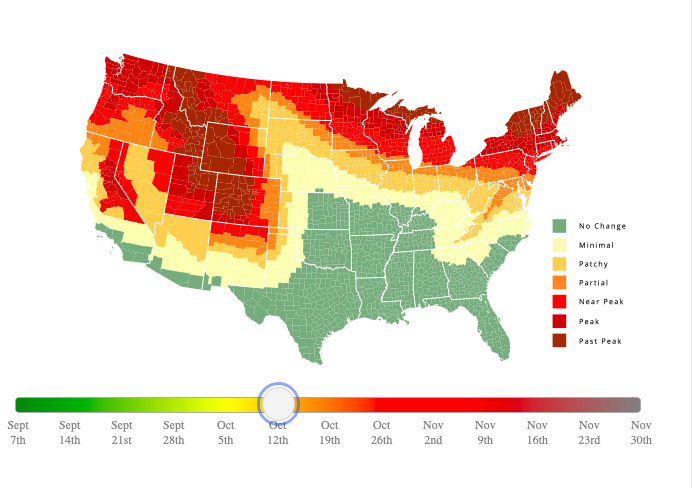
Okay, so there’s a few chores to do. But Mother Nature is putting on a show over the next few weeks. And if you’re planning to travel to view the colors change and learn when we’ll be at peak here on Long Island or elsewhere, a good foliage map is produced by the Smoky Mountain National Park (link).

Below is a screen shot of their map showing Long Island should be at near peak color around October 12th. But it’s always a good idea to get updates because rain, wind and rapid temperature changes can affect the timing.
 

Smoky Mountain National Park map

Smoky Mountain National Park map


Also! A great link for the best places for apple picking on Long Island can be found at mommypoppins.com.  We also have a screen shot of their feature article on this (below).


From Mommypoppins.com

From Mommypoppins.com


By |2019-10-03T13:28:19-05:00October 3rd, 2019|Koi Ponds, Landscaping, Living Landscapes, outdoor maintenance, Plantings/Pondscapes, Ponds & Water Features, Seasonal Landscapes, Updating Landscape|Comments Off on Use Pond Netting: Like Apples, Leaves Don’t Fall Far From the Tree

Choosing a Recreational Pond Over a Swimming Pool

Most people are pretty certain their family will enjoy using a regular pool. But not everyone is so sure about a recreational pond.

Even after learning that these ponds are a growing international trend and are so much better for the environment, they think, why rock the inflatable pool boat so to speak.

However, if like some of Deck and Patio’s Long Island client families, your passion for eco-friendly spaces makes you want to at least ponder (ahem) a recreational pond, one way to test the waters is ask: Do we like swimming in lakes, the ocean, and/or swimming holes? 

If the answer is yes to any of these, then you’ll probably love a natural swimming pond. Why? Because if you’ve swum in the ocean, for example, you’ve probably brushed up against the occasional bit of seaweed and snorkeled to get up close to colorful fish. 

In addition, because swimming in a natural pond means you won’t be swimming in chlorinated water, there’ll be no red eyes or irritated skin.

Because of the benefits to the environment a natural swimming pond offers, and the sheer pleasure families get from them, we’ve been staying on top of the different ponds being constructed across the country. In particular, we keep close watch on the work of the company that crafts the products we use for most of our water features — Aquascape Inc., St. Charles, IL.

And no more so than recently. For in the past year, Aquascape’s main focus, through their Aquascape Construction arm, has been on the design and construction of recreational ponds. And if Aquascape is all in, we’re confident this trend will be growing even wider.

The feature photo at the top of our blog page today is of an Aquascape Construction’s recreational pond that they built last fall in Arlington Heights, Illinois, and which they recently shared on Facebook. Here’s the video of their amazing pond:


Their pond sure is a beauty, isn’t it? And as much as we love gushing about our mentor, Aquascape, we’re proud to say Deck and Patio has done some nice recreational ponds at home on Long Island.

Here’s one very special award-winner!

Recreational Swimming Pond (Long Island/NY):

Recreational Swimming Pond (Long Island/NY):

This pond (above) is one of two ponds the clients had us create in their yard which overlooks Long Island Sound. We can assure you our beautiful model is not avoiding any of the natural pond experience by using a floating device. As you’ll see from the next photo below, she’s not bothered at all by healthy pond life. Indeed, this pond is pure and clean — a joy to swim in.

Pristine Swimming Ponds (Long Island/NY):

Pristine Swimming Ponds (Long Island/NY):

“A key factor in a good natural swimming pond is to build it big and deep enough so that you can snorkel as well as have room to swim,” says Deck and Patio’s Dave Stockwell.


Pond Water Feature Includes Stream and Landscaping (Long Island/NY):

Pond Water Feature Includes Stream and Landscaping (Long Island/NY):

The water feature being enjoyed by our lovely model in the two previous photos includes not only two ponds but also this beautiful stream that feeds them — which Deck and Patio  landscaped with lush plantings and river rock.


Swimming With the Koi (Photo: Courtesy of Aquascape Inc.)

Swimming With the Koi (Photo: Courtesy of Aquascape Inc.)

The child in all of us loves natural swim ponds. This photo was published originally by a homeowner who wrote an Aquascape Inc. blog “Growing Up Around a Pond.” She captured  her son in the photo encouraging a friend to join him in the pond.

A Note on Recreational Pond Maintenance

Eco-friendly recreational ponds require expertise to create a natural swimming  environment to be enjoyed much like swimming holes were in years past. It takes, for example, the correct underlayment, liner, Biofalls (from Aquascape Inc.), bog filtration, as well as the ideal water plants. 

As Aquascape said on Facebook, “The proper amount of filtration and aeration is included in the installation so that maintenance is kept to a minimum.”


Outdoor Living: Fall Is the Ideal Grilling Season

Updated 8-31-23

Memorial Day Weekend kicks off the outdoor season. And many of love weather that allows us to lounge by the pool, etc. But as summer progresses, slogging over a hot grill in 90-degree heat isn’t fun. 

And that’s why fall is the ideal grilling season. The outdoor weather is still welcoming. But no insufferable heat. A little chill in the air is refreshing. We can stand by the grill and literally never work up a sweat.

The good news is fall will be here officially in a few weeks. So let’s look to our grills, our smokers, and outdoor fridges. And if upgrades are needed, now is certainly the time.


Grill Season Upgrades

Outdoor Grilling Continues Through Fall

Outdoor Grilling Continues Through Fall

If you have been planning to upgrade your charcoal or gas trill to a full outdoor kitchen, but were wondering if it’s getting a bit too late to bother, consider that the grilling season lasts all through fall. 

“Even better, outdoor kitchens can be installed fairly quickly,” says Dave Stockwell, owner of Deck and Patio. “Planning for such an amenity isn’t too challenging. There’s the need to determine the kitchen’s best location for optimal outdoor living enjoyment, and also enabling a hook up to water and power sources. But these things usually aren’t difficult.”


Deck and Patio Placed Outdoor Kitchen Amenities Inside Pavilion

Deck and Patio Placed Outdoor Kitchen Amenities Inside Pavilion


Water and electricity are important because an outdoor kitchen encompasses much more than just a barbecue. In most cases they include a sink, refrigerator, a gleaming grill, cabinets for all kinds of storage, and some sort of masonry construction.

There are lots of ways to do this. They can be contained in one elegant outdoor kitchen/bar, or you can have the barbecue on its own and put the other amenities elsewhere.


An Outdoor Kitchen Can be Cost-Effective

An Outdoor Kitchen Can be Cost-Effective

“We find sometimes that clients opt for a fully-equipped outdoor kitchen as a more cost-effective way to extending their indoor cooking area — without having to remodel the whole kitchen,” adds Dave. “This is especially true when the home is on the smaller side.”

Of course, says Dave, even those who already have large modern indoor kitchens love the convenience of an outdoor center that can become the heart of outdoor parties and gatherings — this will be especially important during the holiday season, when an extra oven and prep space can be so helpful.”


With that in mind, let’s look at a sampling of the the various designs and sizes of outdoor kitchens Deck and Patio has built all across Long Island.


Outdoor Kitchen on Lower Patio

Outdoor Kitchen on Lower Patio

This outdoor kitchen’s amenities, built on the lower of two new Deck and Patio patios, include a built-in stainless steel grill, expansive work area, sink, refrigerator and eating/drinking bar with stools. 

Both patio areas were built with Borealis’ modular slabs from Techo-Bloc. Note how the colorful umbrellas behind the outdoor kitchen can be moved as needed in their yard, and offer such nice pops of color wherever they are positioned.

Their new custom fire pit is overlaid in a facade of natural stone that mimics that of their outdoor kitchen.


Outdoor Kitchen with Ronda insulated drawers

Outdoor Kitchen with Ronda insulated drawers

Deck and Patio frequently locate outdoor kitchens fairly close to the inside of the house — unless the property has a destination pool. In the case where all the outdoor living areas are a distance from the house, this requires different planning.

As for the particular amenities show here, one trend we’re seeing in outdoor kitchens are warming/cooling drawers made by companies like Ronda. These insulated drawers are sealed and work without electricity. Your drinks stay cool or your food stays warm depending on what you put in its lower drawer.

They have a magnetic seal, which along with being waterproof will also keep away bugs and dust. Indeed, you can choose a single drawer just for keeping dishes and cutlery completely clean.


Outdoor Kitchens:

Outdoor Kitchens:

Deck and Patio used a natural stone for the veneer of the bar/barbecue and constructed a seat wall made of the same veneer, with the same edge-restraint as the capstone for the seat wall. This created a unique contrast between the patio, bar area and the extensive back veneer used for the house.


Deck Outdoor Activity Center:

Deck Outdoor Activity Center:

For this project, Deck and Patio constructed a custom activity area on the mid-level of a 3-level deck. Just steps from the top-level’s large seating area, the custom outdoor kitchen/dining area includes a new grill, refrigerator, a small bar to enjoy the water views, and even a smoker/cooker — all set within curved custom cabinetry with a raised bar that mimics the decking in style and design.

Wherever you locate your kitchen, just remember you don’t want to get burned up from intense sun during cooking or dining. A pergola is one answer. But another is to have moveable — yet sturdy — outdoor umbrellas for flexible shade.


Outdoor Bar/Dining Area

Outdoor Bar/Dining Area

A bar/dining area is a great place for guests and family to gather. In this case, it’s a truly peaceful spot since we installed a water feature with waterfalls next to their new portable hot tub. It creates a great atmosphere for conversation and enjoying an outdoor meal and drinks.

The bar and outdoor kitchen counter was constructed in a curved shape to mimic the patio design. It is granite topped and the base of the activity center is faced in natural stone. The lounging area’s outdoor umbrella is portable and can be used where needed, including at the bar/kitchen.


Outdoor Kitchen/Bar with Pergola:

Outdoor Kitchen/Bar with Pergola:

Of course, if you prefer permanent shade over your outdoor kitchen/dining area you can opt for a pergola like this custom one we built poolside. With a stainless grill, refrigerator, sink, storage areas, and a custom rock facade, the outdoor kitchen boasts a bar/dining area as well — a great escape after leaving the pool.


The Beatles

The Beatles


So! For great outdoor living all through fall, just remember what The Beatles used to sing!

Landscaping Trends: No Exercise Required When ‘Forest Bathing’

We’re happy to say that in a blog early last year entitled, 2018 Landscaping Trends: ‘Forest Bathing’ on Long Island, NY, we shared with our Long Island neighbors the nascent landscaping trend of ‘forest bathing.’

Well, just this week, The Daily Beast reported how broad this tend has become of late in states like Colorado. But before we get into that, let’s get clear again on what ‘forest bathing’ is and is not.   

Bathing in the Beauty of a Wooded Area

Bathing in the Beauty of a Wooded Area

Forest bathing is a Japanese landscaping trend that does not require a bathing suit — or wild evening romps in the moonlight.

It simply means bathing yourself in the beauty of a wooded area via a nature walk. The idea is to allow your inner spirit time to breathe — and any inner tensions to find release.

And as the Daily Beast pointed out, this is not about trekking, mountain biking, or strenuous exercise. It’s quite the opposite. Indeed, ‘no exercise required.’ Just moments of peaceful introspection in a natural outdoor haven. 

Deck and Patio has found that all this comes natural to Long Islanders. In our years of collaboration with many nature-loving clients, we’ve been designing such restful woodland backyard escapes for many years.

Here are a few examples of how Deck and Patio-landscaped just such ‘forest bathing’ areas for a few of our clients.


'Forest Bathing' Opportunity on Long Island, NY:

‘Forest Bathing’ Opportunity on Long Island, NY:

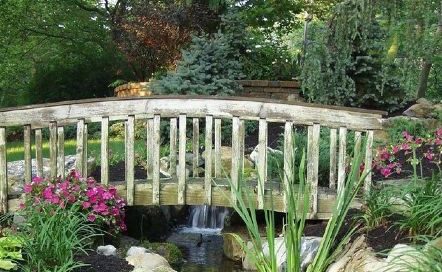
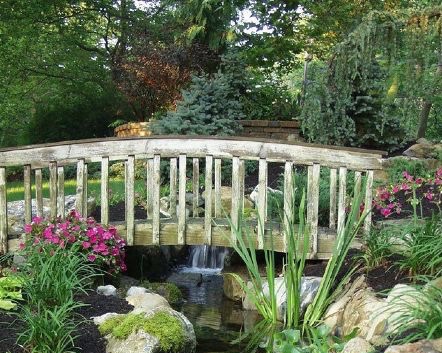
This is a great example of a pre-existing wooded area on a local property. Within this already beautiful setting, we added stone steps, streams and waterfalls. The clients already had a bridge so we designed water features and stepping areas to fit around it.

We also added additional plantings and lots of green ground cover. It’s the perfect space for them to bathe in natural beauty before they start their day and when they return home.


Forest Bathing Offers Great Escape (Long Island/NY):

Forest Bathing Offers Great Escape (Long Island/NY):


The key to forest bathing is to create or update spaces as they appear in nature — and add only amenities that fit naturally in that environment.

In this case, Deck and Patio added a bridge, water feature, imported boulders and rocks and landscaped it with robust plantings.

It feels like you are in upstate New York, in the mountains. Yet, it’s right in our clients’ backyard.


Protecting Woodlands on Long Island/NY:

Protecting Woodlands on Long Island/NY:

As you can see from this Deck and Patio-designed backyard refuge, we were careful to safeguard the existing woodland areas.

Extending out from the parkland areas, the new water feature was brought forward to the entertaining areas through the addition of a pondless waterfall. 

The new multi-level patios were carefully designed so that each patio space had a specific use. The complete project was a perfect blend of softscapes with hardscapes.


 Long Island/NY Backyard Nature Walk:

Long Island/NY Backyard Nature Walk:

Many believe that walking in natural surroundings is not only peaceful, but by providing moments of peaceful contemplation, such walks can have a healing effect.

For this space, we took advantage of the family’s desire to hide their pool equipment by creating a private woodland path. We brought in bushes and plantings and fit them among existing old-growth trees. Adding bluestone stepping stones that lead to a larger woodland area contributes to an extended nature walk that is perfect for forest bathing.

This uplifting experience of forest bathing might also include spiritual moments of divine worship. But the essential key is to just give one’s technology-driven life a break, and leave the barbells behind. No place offers a better space for that than a quiet woodland area.

Forest bathing, by the way, is a translation of the Japanese term “shinrin-yoku” — a new philosophy that began in Japan in the 1980s and has been growing as fast as, well, a bamboo forest.


Here’s two quotes to, once again, leave you with:

“Wilderness is a necessity”

— John Muir, environmental philosopher

“Look deep into nature, and then you will  understand everything better.”

— Albert Einstein


Happy forest bathing!


Closing Your Pool Is a Great Time to Plan Upgrades

As Labor Day approaches, families start thinking of closing down their pools for the year. This seasonal routine is also a great time to plan value-based ideas to upgrade your pool and pool area.

Whether or not you do any of the following improvements when closing down the pool, or whether you just discuss ideas for spring, after Labor Day Weekend is a great time to plan with a landscaper renovations that will heighten next year’s outdoor living experience.


Closing your pool is a great time to discuss upgrades

Closing your pool is a great time to discuss upgrades


In-ground Pools

Upgrading Pool Pump

Upgrading Pool Pump

Pumps

It really doesn’t matter if your pool is gunite or vinyl, there is one easy way to upgrade and save big money say pool experts.

“Consider changing your current one-speed filter pump to an energy efficient variable speed pump,” says Dave Stockwell, owner of Deck and Patio.

“These pumps are so efficient that they can cut your energy costs to one sixth of what they currently are. There are several manufactures that offer these pumps including Pentair, Sta-rite and Jandy. And the cost of the new pump is paid back quickly — often in three years or less.”


Coping 

 Pool Coping

Other upgrade ideas would be to simply change the coping, tile and color of your pool. In gunite, there are many color options in marbledusts, pebble finishes and even all-tile pools.

“Here (above) we added dramatic coping to a pool in Oyster Bay, NY. Our design called for installing the coping on the far side of the pool — flush with the lawn.”

Changing Pool Liners

Changing Pool Liners

Liners

In vinyl pools you can also change a staircase, add a bench or swim-out, change the coping, and of course change your old liner.

Liner color choices are almost limitless and it is amazing what a new liner does to an old faded pool as seen in this photo. There are even pebbled colored liners in a tan tone that make them look more like a gunite pool.


Pool Patio Surrounds, Waterfalls

New Patio/Waterfall

New Patio/Waterfall

Renovating around a pool, whether it’s in-ground or not, is sometimes easier than renovating the pool itself. It could be something as easy as fixing a settled or damaged patio.

Other ideas might be changing to a new patio material like Techo-Bloc “Inca” pavers. Tip: Be sure to compact and install enough base to prevent future settling.

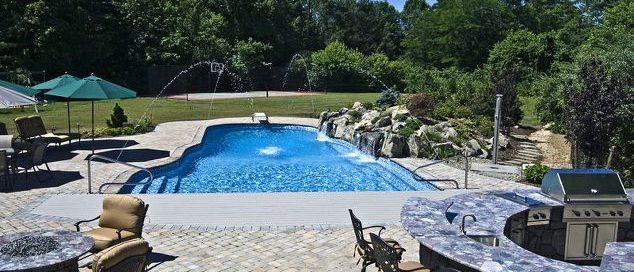
Another popular upgrade is adding a slide, waterfalls, and water sprays (feature photo at top of page shows both sprays and falls). Tip: Insist on a rubber liner under the waterfall to ensure that it will be leak free for a long time.

Have a relaxing Labor Day Weekend…and, then, let’s get planning!


Go to Top